How to Calculate Candle Wax and Fragrance: The Complete Guide (+ Free Calculator)
Calculate exact candle wax amounts, fragrance load percentages, wick sizing, and batch quantities. Includes charts, formulas, and a free calculator.
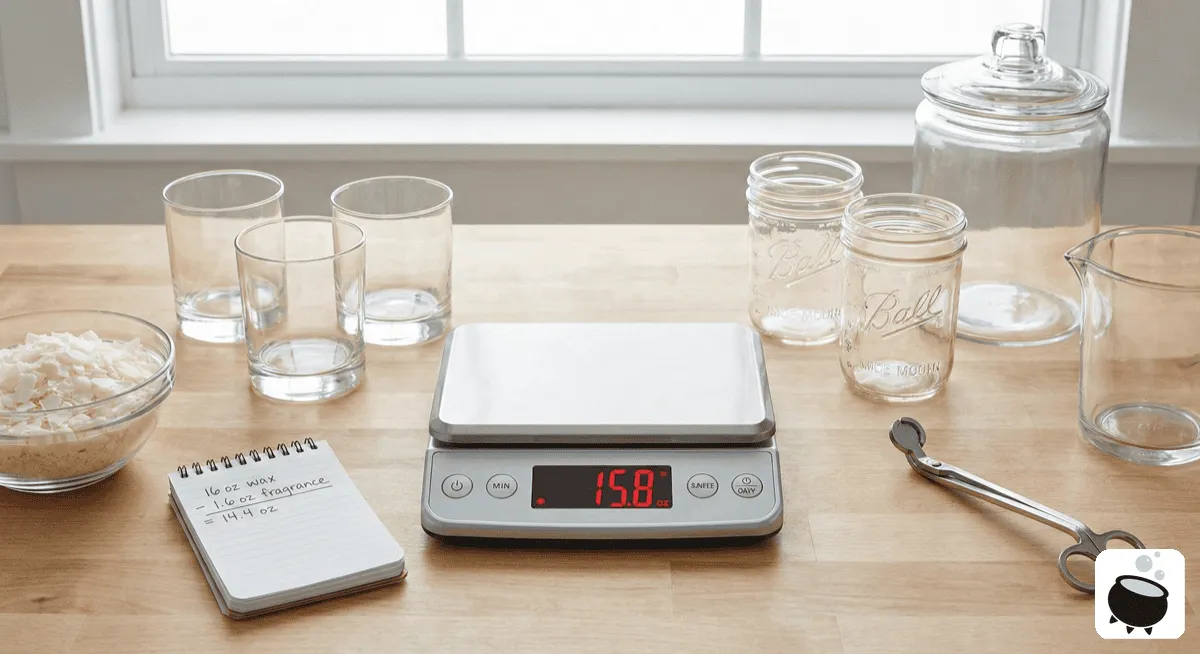
Quick Answer
Calculate candle wax: Container Volume (oz) × 0.86 (soy wax factor) = Wax Needed (oz). Add fragrance at 6-10% of wax weight. For 100 candles in 8 oz jars: 6.9 oz wax × 100 = 690 oz ÷ 16 = 43 lbs soy wax, plus 2.8-4.6 lbs fragrance. Use our free candle calculator to instantly calculate wax, fragrance, and wick sizing for any batch size.
Free Candle Calculator
Calculate exact wax amounts, fragrance loads, and wick sizes for any container size and batch quantity.

Why Precise Calculations Matter
Accurate candle calculations ensure:
- Consistent quality: Same appearance and burn across batches
- Cost efficiency: Buy exactly what you need, no waste
- Production planning: Know material requirements before ordering
- Profitability: Accurate cost per candle for pricing
- Customer satisfaction: Candles perform as advertised
Guessing leads to under-filled or over-filled containers, wasted materials, and inconsistent products.
Wax Calculation Formula
The Basic Formula
Wax Needed (oz) = Container Volume (fl oz) × Conversion Factor
Conversion Factors by Wax Type
| Wax Type | Conversion Factor | Notes |
|---|---|---|
| Soy Wax | 0.86 | Most popular, eco-friendly |
| Paraffin | 0.90 | Traditional, accepts color well |
| Coconut Wax | 0.83 | Blended, excellent scent throw |
| Parasoy (Blend) | 0.87 | Best of both worlds |
| Beeswax | 0.96 | Most dense, natural option |
| Gel (Resin) | 0.92 | Clear, decorative candles |
| Palm Wax | 0.88 | Crystal formations possible |
Why the conversion factor? Wax is denser than water, so an 8 oz container holds about 6.9 oz of wax, not 8 oz. The factor accounts for this density difference.
Example Calculations
8 oz Soy Candle:
8 oz × 0.86 = 6.88 oz soy wax
12 oz Paraffin Candle:
12 oz × 0.90 = 10.8 oz paraffin wax
16 oz Coconut Wax Candle:
16 oz × 0.83 = 13.28 oz coconut wax
Fragrance Oil Calculation
Understanding Fragrance Load
Fragrance load is the percentage of fragrance oil by weight compared to wax weight.
Fragrance Load % = (Fragrance Weight ÷ Wax Weight) × 100
Recommended Fragrance Loads
| Load Level | Strength | Best For |
|---|---|---|
| 4-5% | Light, subtle | Sensitive customers, unscented preference |
| 6-7% | Moderate | Most commercial candles |
| 8-9% | Strong | Strong scent throw needed |
| 10%+ | Very strong | Niche/specialty scents |
Most common: 8-10% fragrance load for adequate scent throw without overwhelming.
Fragrance Calculation Example
For an 8 oz Soy Candle with 8% Fragrance Load:
- Wax needed: 8 oz × 0.86 = 6.88 oz
- Fragrance (8%): 6.88 × 0.08 = 0.55 oz
- Total pour weight: 6.88 + 0.55 = 7.43 oz
This slightly overfills the 8 oz container, so you can either:
- Reduce wax to 6.5 oz (0.43 oz fragrance) for exact fill
- Accept slight overfill
- Use a container 0.5-1 oz larger
Batch Fragrance Calculation
For multiple candles:
Total Fragrance = (Wax per Candle × Load %) × Number of Candles
Example: 50 candles, 8 oz containers, 8% load:
- Wax per candle: 8 × 0.86 = 6.88 oz
- Fragrance per candle: 6.88 × 0.08 = 0.55 oz
- Total wax: 6.88 × 50 = 344 oz
- Total fragrance: 0.55 × 50 = 27.5 oz
Convert to lbs:
- Wax: 344 ÷ 16 = 21.5 lbs
- Fragrance: 27.5 ÷ 16 = 1.72 lbs (about 27 oz)
Container Size Quick Reference
Soy Wax Calculations (0.86 Factor)
| Container Size | Wax per Candle | Fragrance (8%) | Per Dozen + 10% |
|---|---|---|---|
| 4 oz | 3.4 oz | 0.27 oz | 45 oz wax / 3.6 oz frag |
| 6 oz | 5.2 oz | 0.42 oz | 68 oz wax / 5.4 oz frag |
| 8 oz | 6.9 oz | 0.55 oz | 91 oz wax / 7.3 oz frag |
| 10 oz | 8.6 oz | 0.69 oz | 114 oz wax / 9.1 oz frag |
| 12 oz | 10.3 oz | 0.82 oz | 136 oz wax / 10.9 oz frag |
| 16 oz | 13.8 oz | 1.10 oz | 182 oz wax / 14.6 oz frag |
| 20 oz | 17.2 oz | 1.38 oz | 227 oz wax / 18.2 oz frag |
Paraffin Wax (0.90 Factor)
| Container | Wax per Candle | Fragrance (8%) | Per Dozen + 10% |
|---|---|---|---|
| 8 oz | 7.2 oz | 0.58 oz | 95 oz wax / 7.6 oz frag |
| 12 oz | 10.8 oz | 0.86 oz | 143 oz wax / 11.5 oz frag |
| 16 oz | 14.4 oz | 1.15 oz | 190 oz wax / 15.2 oz frag |
Coconut Wax (0.83 Factor)
| Container | Wax per Candle | Fragrance (8%) | Per Dozen + 10% |
|---|---|---|---|
| 8 oz | 6.6 oz | 0.53 oz | 87 oz wax / 7.0 oz frag |
| 12 oz | 9.96 oz | 0.80 oz | 132 oz wax / 10.6 oz frag |
| 16 oz | 13.3 oz | 1.06 oz | 176 oz wax / 14.1 oz frag |
Accounting for Additives and Dyes
Dyes and Colorants
Candle-specific dyes and micas are added in small amounts that don't significantly affect fill level:
- Wax dyes: 0.5-1% by weight (minimal impact)
- Mica/glitter: 1-2% by weight (minimal impact)
- Iron oxides: 0.5-1.5% by weight (minimal impact)
Rule: For less than 3% total additives, ignore volume impact. Don't adjust wax calculations.
Fragrance Oil Impact
Fragrance oil counts toward total pour weight, so wax adjustment is necessary (as shown above).
Coconut Coir and Other Fillers
Some makers add fillers for visual effect. These add weight but not volume, so adjust wax down slightly:
Adjusted Wax = Standard Wax - (Filler Weight)
Wick Sizing: A Critical Variable
Wrong wick size ruins candles. Too small = poor scent throw and slow melt pool. Too large = smoking and soot.
Wick Sizing by Container Diameter
| Container Diameter | Recommended Wick Type | Size |
|---|---|---|
| 2-2.5" | Paper-core ply | 16-20 |
| 2.5-3" | Cotton ply | 18-24 |
| 3-3.5" | Cotton ply | 24-30 |
| 3.5-4" | Cotton ply | 30-36 or braided |
| 4"+ | Double wick or thick braided | 36+ each |
Example: 8 oz jar with 3" diameter = ply 24 cotton wick
Testing for Correct Wick Size
Burn test candles:
- Burn for 2-4 hours
- Assess melt pool (should reach container edge after 1-2 hours)
- Check for smoking or tunneling (uneven melting)
- Evaluate scent throw (can you smell it from 6 feet away?)
Adjustments:
- If melt pool shallow: use larger wick
- If smoking/excess soot: use smaller wick
- If no scent throw: might be fragrance load or wick size issue
Double-Wick vs. Single Wick
| Container Size | Single Wick | Double Wick |
|---|---|---|
| Up to 12 oz | Standard | Only if poor melt |
| 12-16 oz | Possible | Recommended |
| 16 oz+ | Not recommended | Standard |
Double wicks (separate wick in same container) improve scent throw and melt pool on larger candles.
Calculating for Custom Container Dimensions
If you don't know container volume:
For Cylindrical Containers
Volume (cubic inches) = π × radius² × height
Volume (fl oz) = cubic inches ÷ 1.805
Example: 3" diameter, 4" height cylinder
- Radius = 1.5"
- Volume = 3.14159 × 1.5² × 4 = 28.3 cubic inches
- Fluid ounces = 28.3 ÷ 1.805 = 15.7 fl oz
- Soy wax needed = 15.7 × 0.86 = 13.5 oz
For Square/Rectangular Containers
Volume (cubic inches) = length × width × height
Volume (fl oz) = cubic inches ÷ 1.805
Example: 3" × 3" × 4" square jar
- Volume = 3 × 3 × 4 = 36 cubic inches
- Fluid ounces = 36 ÷ 1.805 = 19.9 fl oz
- Soy wax needed = 19.9 × 0.86 = 17.1 oz
Batch Scaling and Production Planning
Calculating Total Materials for Large Batches
For a production run, multiply per-candle calculations by quantity and add waste buffer.
Example: 100 candles, 8 oz, soy, 8% fragrance
| Item | Calculation | Total |
|---|---|---|
| Wax per candle | 6.88 oz | 688 oz |
| Total wax | ÷ 16 oz/lb | 43 lbs |
| Add 10% buffer | 43 × 1.10 | 47.3 lbs |
| Fragrance per candle | 0.55 oz | 55 oz |
| Total fragrance | ÷ 16 oz/lb | 3.4 lbs |
| Containers | 100 units | 100 |
| Wicks | 100 units | 100 |
Converting Pounds to Candle Capacity
Work backward to know production capacity:
Candles Possible = (Wax in lbs × 16) ÷ (Wax per Candle × 1.10)
Example: 50 lbs soy wax, 8 oz containers
- 50 lbs × 16 = 800 oz
- Per candle with waste: 6.88 × 1.10 = 7.57 oz
- Candles: 800 ÷ 7.57 = 105 candles
Common Calculation Mistakes
Mistake 1: Confusing Volume and Weight
"An 8 oz container holds 8 oz of wax."
No. The "8 oz" refers to fluid volume, not wax weight. Soy wax fills at 0.86 oz per fluid oz.
Mistake 2: Ignoring Fragrance Volume
Fragrance oil adds to the total weight. If you calculate wax exactly and add 10% fragrance, you'll overfill.
Solution: Either reduce wax slightly or accept slight overfill and trim after cooling.
Mistake 3: Not Adding Waste Margin
Calculating exact amounts means running out. Always add 10-15% buffer for:
- Spills and splashes
- Pot residue
- Testing batches
- Topping off sinkholes post-cure
Mistake 4: Using Same Fragrance Load for All Fragrances
Some fragrance oils are stronger than others. Light fragrances might need 10%, while strong ones perform well at 6%.
Test: Make small test batches at different loads and burn-test to find optimal range.
Mistake 5: Inconsistent Units
Mixing ounces, grams, and pounds causes errors. Pick one unit and stick with it throughout calculations.
Mistake 6: Wrong Conversion Factor for Wax Type
Using soy's factor (0.86) for paraffin (0.90) means under-filled candles or wrong cost estimates.
Using a Fragrance Load Calculator
Different fragrance oils perform differently. Track your results:
| Fragrance | Load % | Scent Throw | Notes |
|---|---|---|---|
| Lavender essential | 6% | Moderate | Natural, fades slightly |
| Vanilla fragrance | 8% | Strong | Heat activates scent |
| Floral blend | 10% | Very strong | Can be overwhelming |
| Citrus essential | 7% | Moderate-strong | Fresh, bright |
Our free candle calculator tracks favorite fragrance loads across scents, saving you from recalculating:
Free Fragrance Calculator
Calculate fragrance loads, track scent strength results, and optimize load percentages for consistent aromatic experience.
Wax, Fragrance, and Temperature
Pour Temperature
Temperature affects how well fragrance distributes:
| Wax Type | Pour Temp | Notes |
|---|---|---|
| Soy | 170-185°F | Lower temp = better scent retention |
| Paraffin | 180-200°F | Can tolerate higher temps |
| Coconut | 165-180°F | Sensitive to temperature |
Pour at manufacturer recommendation for your specific wax.
Fragrance Adhesion
Fragrance oils bond better at slightly cooler temperatures. Some makers cool wax to 170°F before adding fragrance for better dispersion.
Heat-Sensitive Fragrance
Some delicate fragrances (florals, fresh scents) break down at high temps. Use lower pour temps with these.
Frequently Asked Questions
How much fragrance oil should I use?
Start at 8% of wax weight. Burn-test small batches. Adjust up to 10% for stronger scent throw or down to 6% for subtlety. Never exceed 12% (fragrance won't bond properly).
Why do my candles have weak scent throw?
Possible causes: fragrance load too low, pour temperature too hot, wick too small (insufficient melt pool), or fragrance oil quality. Adjust load, temperature, or wick size incrementally.
Can I calculate candle costs with this information?
Yes. Use container volume × conversion factor to know wax amount. Track fragrance at percentage. Multiply by unit costs to calculate per-candle material cost. Add labor and overhead for total cost.
What's the difference between fragrance oil and essential oil in candles?
Fragrance oils are synthetic or blended; they hold better in candles and produce stronger scent. Essential oils are natural but volatile and break down with heat. Use fragrance oils for candles unless specifically blending essential oil candles (which require different formulations).
How do I scale a recipe that uses decimal measurements?
Keep decimals. If calculating for 50 candles, multiply per-candle amount by 50, even if result is a decimal. Convert to grams for precision (0.1 oz = 2.8 grams).
Should I round measurements?
For fragrance and small amounts, round to nearest 0.1 oz. For wax quantities over 10 oz, rounding to 0.5 oz is acceptable. Precision matters more at small scales.
Can I reuse leftover wax from the pouring pot?
Yes. Save it for future batches. If fragrant, track which fragrance was used. Combine only compatible scents.
Advanced: Customizing Fragrance Blends
When blending fragrances, maintain total load percentage:
Example: 8 oz candle with 8% fragrance blend
Total fragrance: 6.88 × 0.08 = 0.55 oz
Blend two fragrances:
- Lavender (60%): 0.33 oz
- Vanilla (40%): 0.22 oz
- Total: 0.55 oz (maintains 8% load)
Same calculation for any number of fragrances. Always total to desired load percentage.
Conclusion
Accurate wax and fragrance calculations eliminate guesswork from candle making. Calculate wax using container volume and conversion factor. Add fragrance at 6-10% of wax weight. Select wick size based on container diameter.
For single test candles or production runs of 100+, use our free candle calculator to instantly compute wax amounts, fragrance requirements, and wick sizing recommendations.
Consistent calculations mean consistent quality, accurate costs, and efficient production. Whether making hobby batches or running a commercial candle line, precision in these calculations directly impacts profitability and customer satisfaction.
Master these formulas. Document your test results. Scale with confidence.
Try These Free Tools
Skip the Manual Math
PotionHub calculates lye, tracks batches, manages inventory, and scales recipes for you. Free during beta - no credit card required.
Get PotionHub Free