Candle Fragrance Load: How Much Fragrance Oil to Use in Candles
Learn the right fragrance load percentage for every wax type. Includes fragrance oil calculator formulas, max load charts, and tips for getting the strongest scent throw.
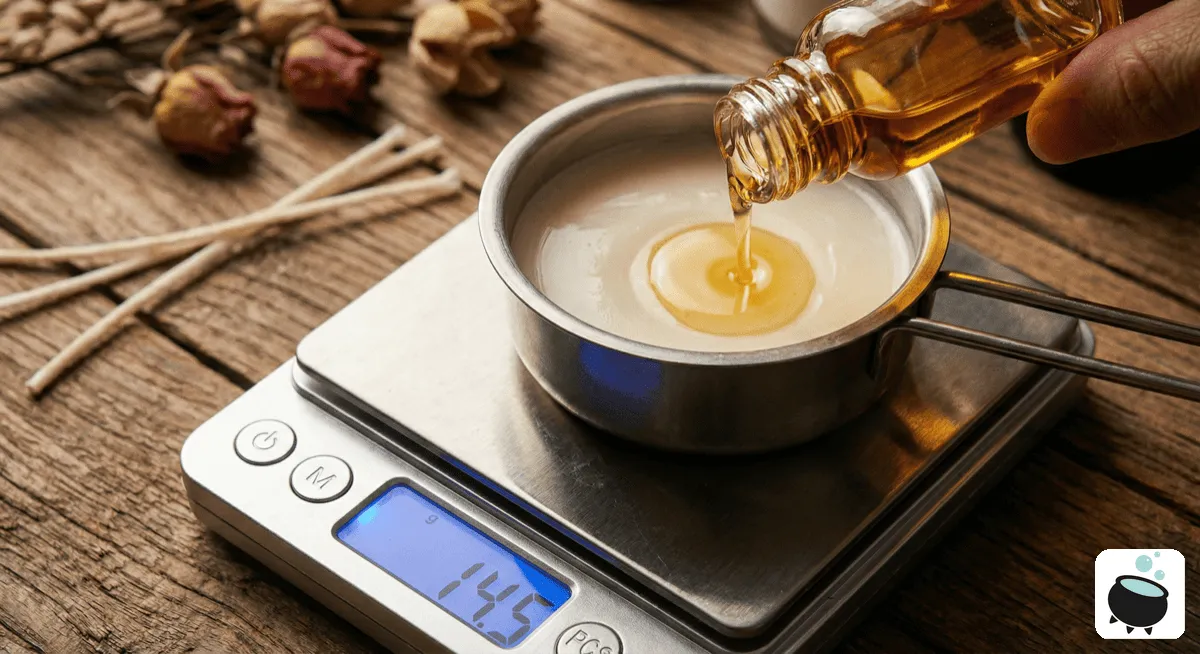
Quick Answer
The basic formula for calculating fragrance oil:
Fragrance Oil (oz) = Wax Weight (oz) × Fragrance Load %
Most candle waxes accept between 6-10% fragrance load, but this varies significantly by wax type. Use our free candle fragrance calculator to instantly determine the exact amount of fragrance oil needed for your batch size.
Free Candle Fragrance Calculator
Calculate exact fragrance oil amounts for any wax type, container size, and batch quantity.

What Is Fragrance Load?
Fragrance load is the percentage of fragrance oil mixed into your melted wax, expressed as a percentage by weight. It determines how much scent your candle will throw—both when burning (hot throw) and sitting unlit (cold throw).
For example, if you're making a 1-pound candle with 10% fragrance load, you would add 1.6 ounces of fragrance oil to 14.4 ounces of wax. That 1.6 ounces represents 10% of the total weight.
Why does this matter? Many candle makers assume "more fragrance equals stronger scent," but this is incorrect. Every wax has a maximum fragrance load—the highest percentage it can absorb and hold effectively. Exceeding this threshold causes:
- Fragrance sweating: Oil seeping out onto the candle surface
- Poor scent throw: Paradoxically, overfragranced candles often smell weaker
- Structural problems: Wet spots, sinkholes, and uneven burning
- Flash point issues: Compromised candle safety
- Wick problems: Excessive oil can cause mushrooming and smoking
Finding the right fragrance load for your specific wax is essential for creating quality candles that burn cleanly and smell amazing.
Maximum Fragrance Load by Wax Type
Different wax blends have different maximum fragrance loads. This table shows recommended ranges for the most popular candle waxes:
| Wax Type | Max Fragrance Load | Recommended Range | Notes |
|---|---|---|---|
| Soy 464 | 10% | 8-10% | Industry standard, excellent scent throw, holds fragrance reliably |
| Soy 444 | 8% | 6-8% | Slower wax, works well for economy candles, slightly lower capacity |
| Paraffin | 12% | 10-12% | Highest fragrance load capacity, excellent hot throw, not eco-friendly |
| Coconut (100%) | 8% | 6-8% | Needs careful measuring, holds fragrance well but lower capacity than blends |
| Beeswax | 8% | 6-8% | Limited capacity, natural smell can compete with fragrance, expensive |
| Parasoy Blends | 10% | 8-10% | Combines paraffin and soy, excellent scent throw and sustainability |
| Coconut-Soy Blends | 10% | 8-10% | Modern choice, strong scent throw, good burn performance |
Important: Always check your specific wax manufacturer's recommendations. Wax formulations vary, and reputable suppliers provide detailed fragrance load specifications.
How to Calculate Fragrance Oil
Let's walk through several practical examples using the fragrance load formula.
Example 1: Simple Soy Candle
You're making a candle with 16 ounces of soy 464 wax. You want to use the maximum recommended load of 10%.
Fragrance Oil = 16 oz × 0.10 = 1.6 oz
You need 1.6 ounces of fragrance oil.
Example 2: Coconut Wax with Conservative Load
You have 24 ounces of 100% coconut wax but want to be conservative with fragrance to ensure good performance. You choose 7% load.
Fragrance Oil = 24 oz × 0.07 = 1.68 oz
You need approximately 1.7 ounces of fragrance oil.
Example 3: Paraffin Candles in Bulk
You're batch-making and have 100 pounds of paraffin wax. You want to use 11% fragrance load (within the safe maximum of 12%).
First, convert pounds to ounces: 100 lbs × 16 oz/lb = 1,600 ounces
Fragrance Oil = 1,600 oz × 0.11 = 176 oz
Convert back to pounds: 176 oz ÷ 16 = 11 pounds of fragrance oil.
Example 4: Blended Wax with Mid-Range Load
You're making a 5-pound batch of coconut-soy blend and want 9% load.
Convert to ounces: 5 × 16 = 80 ounces
Fragrance Oil = 80 oz × 0.09 = 7.2 oz
You need 7.2 ounces of fragrance oil.
Hot Throw vs Cold Throw
Understanding the difference between hot and cold throw helps you optimize your fragrance load for what your customers care most about.
Hot Throw is the scent intensity when the candle is lit and burning. The heat from the flame vaporizes fragrance molecules, creating scent distribution throughout the room. Factors affecting hot throw:
- Wax type: Paraffin has the strongest hot throw; coconut has the weakest
- Fragrance load: Higher loads generally improve hot throw (up to maximum capacity)
- Wick size: A larger wick creates more heat and stronger scent distribution
- Room size: Scent travels further in smaller spaces
- Fragrance type: Some essential oils and fragrance compounds are more volatile than others
Cold Throw is the scent you smell when the candle is sitting unlit on a shelf. This is what customers smell in a store before deciding to buy. Cold throw factors:
- Fragrance load: Higher loads improve cold throw proportionally
- Fragrance compound: Some fragrances are more readily released at room temperature
- Container material: Clear glass allows scent to escape more easily than opaque containers
- Time: Cold throw often improves during the first 2-3 weeks of cure time
- Top notes: The initial volatile compounds (top notes) fade quickly, affecting perceived cold throw over time
The Balance: Most candle makers prioritize hot throw because customers judge candles primarily by how they smell while burning. However, cold throw matters for retail presentation. A well-designed candle should have 8-10% fragrance load to maintain excellent performance in both metrics.

Tips for Maximum Scent Throw
- Choose the right wax for your priority: Paraffin offers the strongest throw; soy-coconut blends offer a good balance; 100% coconut requires careful management.
- Stay within the maximum fragrance load: Going over the limit doesn't increase scent throw—it causes performance problems. Respect the wax's capacity.
- Use quality fragrance oils: Premium fragrance oils contain more potent scent compounds and perform better at lower percentages than budget options. The difference is noticeable.
- Measure by weight, not volume: Never use measuring cups or syringes. Always use a digital scale accurate to 0.1 ounces. Volume measurements are inconsistent and lead to miscalculations.
- Let wax cure before judging scent: New candles haven't fully cured. Cold throw and hot throw improve during the first 3-7 days. Don't panic if a fresh candle seems weak.
- Pair fragrance load with wick size: A thin wick burning a highly fragranced candle won't create enough heat for good hot throw. Match your wick to the fragrance load and wax type.
- Consider your room size target: If customers use candles in small bathrooms, 10% fragrance load with a small room-filling wick works great. For large living rooms, you might suggest two candles or accept that a single candle won't fill a 2,000 sq ft space.
- Test your fragrance oils: Before making 50 candles, test a small batch with your chosen fragrance oil and load percentage. What works for one fragrance might not work for another.
- Store fragrance oils correctly: Fragrance oils degrade in heat and sunlight. Store them in cool, dark conditions in tightly sealed containers. Degraded fragrance oil creates weak candles regardless of load percentage.
- Document your recipes: Keep detailed notes of wax type, fragrance oil brand, load percentage, wick size, and performance results. This data helps you replicate successes and avoid repeating mistakes.
Common Fragrance Mistakes
Mistake #1: Using the same load for all wax types
Many beginners use 10% for every wax. This works for soy, but causes problems with coconut (too much) and misses the potential of paraffin (which can handle 12%). Know your wax's capacity.
Mistake #2: Measuring fragrance oil by volume
A cup of one fragrance oil weighs differently than a cup of another. Always use weight. A cheap kitchen scale ($15-25) is a worthwhile investment.
Mistake #3: Exceeding the maximum load "for stronger scent"
This is the most common mistake. 12% fragrance in a 10%-max wax doesn't smell twice as strong—it sweats, performs poorly, and wastes fragrance oil.
Mistake #4: Not accounting for fragrance oil weight in your total
If you need 16 oz total and add 1.6 oz fragrance oil, you only need 14.4 oz of wax (not 16 oz of wax plus 1.6 oz fragrance). The fragrance counts toward total weight.
Mistake #5: Assuming all fragrance oils hold the same
Some fragrances migrate out of wax over time; others bond permanently. This affects both hot and cold throw. Test unfamiliar fragrances in small batches first.
Mistake #6: Ignoring the manufacturer's specifications
Every wax brand differs slightly. Read your supplier's technical data sheet for maximum fragrance load recommendations specific to their product.
Frequently Asked Questions
Q: Can I use more than the maximum fragrance load if I really want a strong scent?
A: No. Exceeding maximum fragrance load creates the opposite effect. Excess fragrance sweats out of the wax, leaving a weaker scent in the candle itself while creating an oily surface. You'll also see wet spots, sinkholes, and poor burning. The maximum load exists because that's the ceiling of what the wax can hold effectively.
Q: What's the difference between fragrance oil and essential oil?
A: Fragrance oils are synthetic aromatic compounds (or natural compounds mixed with carriers) engineered for candle making. Essential oils are concentrated plant extracts. Essential oils have much lower maximum loads (3-5%), flash point safety issues, and often perform poorly in candles. For candle making, always use fragrance oils specifically designed for candles.
Q: My candles smell strong in cold throw but weak when burning. What's wrong?
A: This suggests an insufficient hot throw. Check your wick size—it might be too thin to create enough heat for fragrance vaporization. You could also try a slightly higher fragrance load (if your wax allows it), or switch to a wax with better hot throw performance like a soy-coconut blend or paraffin.
Q: Do I need to adjust fragrance load for scent type?
A: Yes, somewhat. Heavy scents like vanilla, musk, and gourmands tend to project well even at lower percentages. Lighter scents like florals and fresh/citrus may benefit from the higher end of your wax's range. Test your specific fragrances to understand their projection capabilities.
Q: How long should candles cure before selling?
A: Most candles benefit from 24-48 hours of cure time minimum. However, for optimal scent throw and consistency, cure for 3-7 days. This allows fragrance molecules to fully bond with the wax matrix and cold throw to reach full potential.
Q: Can I mix different wax types and use an average fragrance load?
A: This is risky. If you blend soy (10% max) and coconut (8% max), use the lower limit (8%) to be safe. Better yet, keep your batches consistent with a single wax type until you gain experience.
Q: Why does my fragrance oil separate and collect at the bottom of the container?
A: This usually means you've exceeded the fragrance load capacity. The wax can't hold all the oil, so excess pools. Reduce your fragrance load percentage or switch to a wax with higher capacity.
Q: Should I add fragrance oil to cold wax or melted wax?
A: Always add fragrance to melted wax (around 185°F) after heat removal. Never add fragrance to wax hotter than your fragrance oil's flash point, and never add cold fragrance to hot wax—it can create splattering and uneven distribution.
Conclusion
Fragrance load is the foundation of candle making success. Getting this single variable right determines whether your candles smell amazing or disappointing, burn cleanly or poorly, and keep customers coming back or leaving bad reviews.
The formula is simple: multiply your wax weight by the appropriate fragrance load percentage for your wax type. The science is straightforward: respect your wax's maximum capacity. The results are dramatic: beautifully scented candles with excellent hot throw, reliable cold throw, and clean burning performance.
Whether you're making candles as a hobby or building a business, invest in a quality scale, understand your wax's specifications, test your fragrances, and keep detailed records. These practices turn fragrance load from a guessing game into a repeatable system.
Ready to calculate your candle fragrance? Use our free candle fragrance calculator to instantly determine the exact amounts for your batch.
Try These Free Tools
Skip the Manual Math
PotionHub calculates lye, tracks batches, manages inventory, and scales recipes for you. Free during beta — no credit card required.
Get PotionHub Free