Candle Wax Calculator: How Much Wax Do You Need?
Learn how to calculate the exact amount of wax needed for your candle containers. Includes formulas, charts, and tips for measuring wax accurately every time.
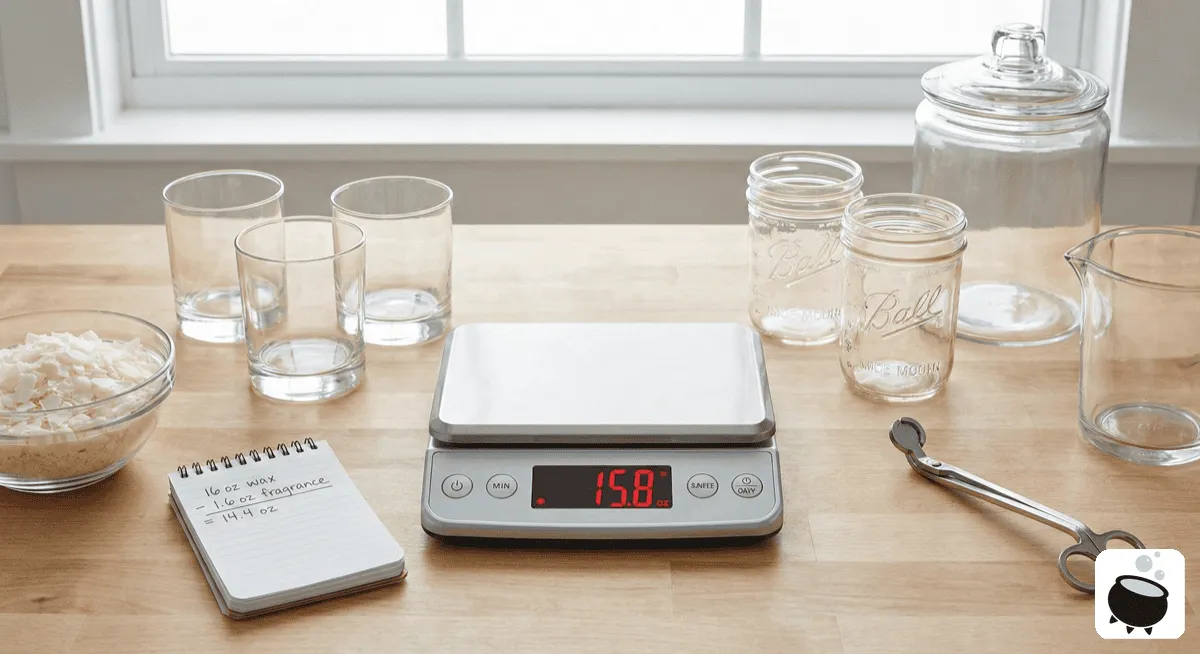
Quick Answer
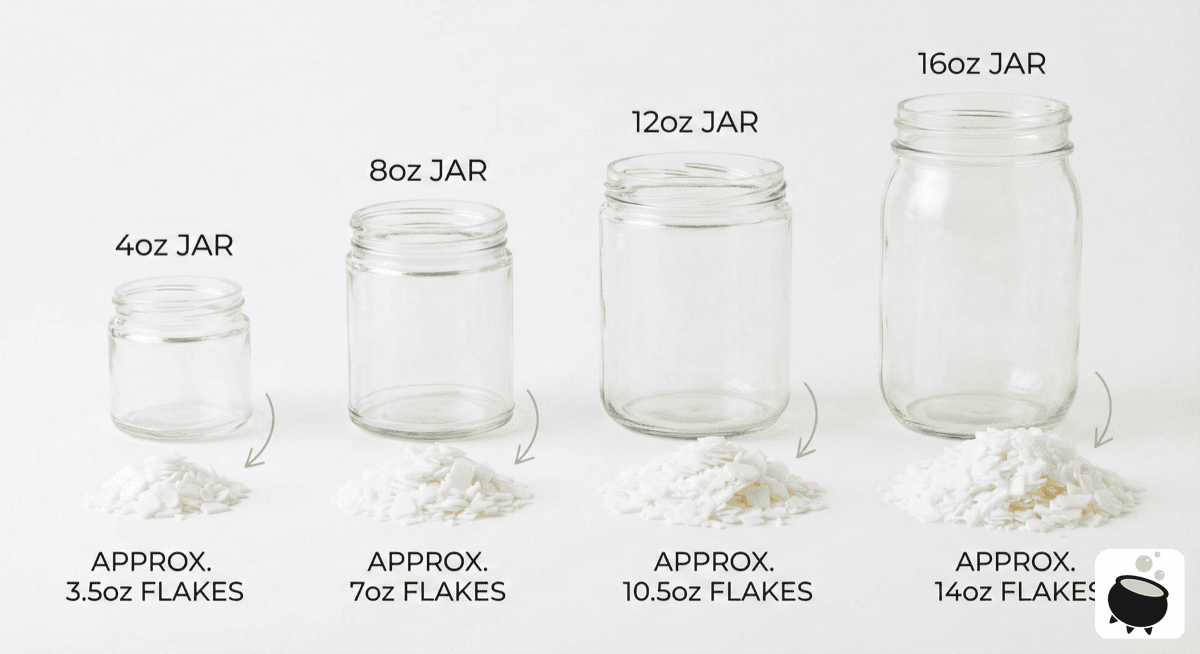
To calculate candle wax: Container Volume (oz) × 0.86 = Approximate Wax Needed (oz). A 12 oz container needs approximately 10.3 oz of wax. For multiple candles, multiply by the number of containers, then add 10-15% extra to account for adhesion and waste.
Skip the math: Use our free candle wax calculator to instantly calculate wax and fragrance amounts with pour temperature and wick size recommendations.
Why Accurate Wax Calculation Matters
Using the right amount of wax ensures:
- Proper fill level - Aesthetically pleasing candles
- Cost efficiency - No wasted wax
- Consistent quality - Same results every time
- Production planning - Know how much to buy
Guessing leads to unfilled candles, wasted materials, and inconsistent products.
The Basic Wax Calculation Formula
Container Volume Method
Most containers list volume in fluid ounces. Since wax is denser than water, you don't need the full volume:
Wax Needed = Container Volume (fl oz) × 0.86
Why 0.86? Soy wax weighs about 0.86 oz per fluid ounce of volume. This varies slightly by wax type.
Weight Conversion Factors by Wax Type
| Wax Type | Conversion Factor |
|---|---|
| Soy Wax | 0.86 |
| Paraffin | 0.90 |
| Coconut Wax | 0.83 |
| Parasoy Blend | 0.87 |
| Beeswax | 0.96 |
Example: 16 oz container with soy wax
- 16 oz × 0.86 = 13.76 oz of soy wax needed
Calculating for Multiple Candles
Batch Formula
Total Wax = (Container Size × Conversion Factor × Number of Candles) × 1.10
The 1.10 accounts for 10% extra for waste, adhesion to pot, and margin of error.
Example: 12 Candles in 8 oz Jars
Using soy wax:
- Per candle: 8 oz × 0.86 = 6.88 oz
- Total: 6.88 oz × 12 = 82.56 oz
- With 10% extra: 82.56 × 1.10 = 90.8 oz (about 5.7 lbs)
Container Size Quick Reference Chart
Soy Wax (0.86 factor)
| Container | Wax Needed | Per Dozen + Extra |
|---|---|---|
| 4 oz | 3.4 oz | 45 oz (2.8 lbs) |
| 6 oz | 5.2 oz | 68 oz (4.3 lbs) |
| 8 oz | 6.9 oz | 91 oz (5.7 lbs) |
| 10 oz | 8.6 oz | 114 oz (7.1 lbs) |
| 12 oz | 10.3 oz | 136 oz (8.5 lbs) |
| 16 oz | 13.8 oz | 182 oz (11.4 lbs) |
| 20 oz | 17.2 oz | 227 oz (14.2 lbs) |
Paraffin (0.90 factor)
| Container | Wax Needed | Per Dozen + Extra |
|---|---|---|
| 4 oz | 3.6 oz | 47 oz (3.0 lbs) |
| 6 oz | 5.4 oz | 71 oz (4.5 lbs) |
| 8 oz | 7.2 oz | 95 oz (6.0 lbs) |
| 10 oz | 9.0 oz | 119 oz (7.5 lbs) |
| 12 oz | 10.8 oz | 143 oz (8.9 lbs) |
| 16 oz | 14.4 oz | 190 oz (11.9 lbs) |
Calculating by Container Dimensions
If you don't know your container's volume:
For Cylindrical Containers
Volume (cubic inches) = π × radius² × height
Volume (fl oz) = cubic inches × 0.554
Example: Jar with 3" diameter, 4" height
- Radius = 1.5 inches
- Volume = 3.14 × 1.5² × 4 = 28.3 cubic inches
- Fluid ounces = 28.3 × 0.554 = 15.7 fl oz
- Soy wax needed = 15.7 × 0.86 = 13.5 oz
For Square/Rectangular Containers
Volume (cubic inches) = length × width × height
Volume (fl oz) = cubic inches × 0.554
Accounting for Additives
Fragrance Oil
Fragrance oil adds to your total wax pool. Account for it:
Fragrance at 10% = Wax Weight × 0.10
Total Pour Weight = Wax Weight + Fragrance Weight
Example: 8 oz container
- Wax needed: 6.9 oz
- Fragrance (10%): 0.69 oz
- Total pour: 7.59 oz
This slightly overfills, so adjust wax down or accept higher fill.
Dye and Additives
Small amounts (dye chips, UV stabilizers) typically don't significantly affect fill level. Don't adjust calculations unless adding substantial amounts.
Factoring Waste and Testing
Production Waste
Always calculate 10-15% extra wax for:
- Wax left in melting pot
- Small spills and drips
- Topping off after sinkholes
- Testing and samples
Test Candles
When testing new containers, make a few extra:
- One for burn testing
- One for cut testing
- One as backup
Common Calculation Mistakes
Using Volume = Weight
An 8 oz container doesn't use 8 oz of wax. Wax is lighter than water. Always apply the conversion factor.
Forgetting Fragrance Volume
Fragrance oil counts toward fill. If you calculate wax exactly and add 10% fragrance, you'll overfill.
Not Adding Waste Margin
Calculating exact amounts means running out. Always add 10% minimum for production use.
Inconsistent Units
Mixing ounces, grams, and pounds causes errors. Pick one unit and stick with it.
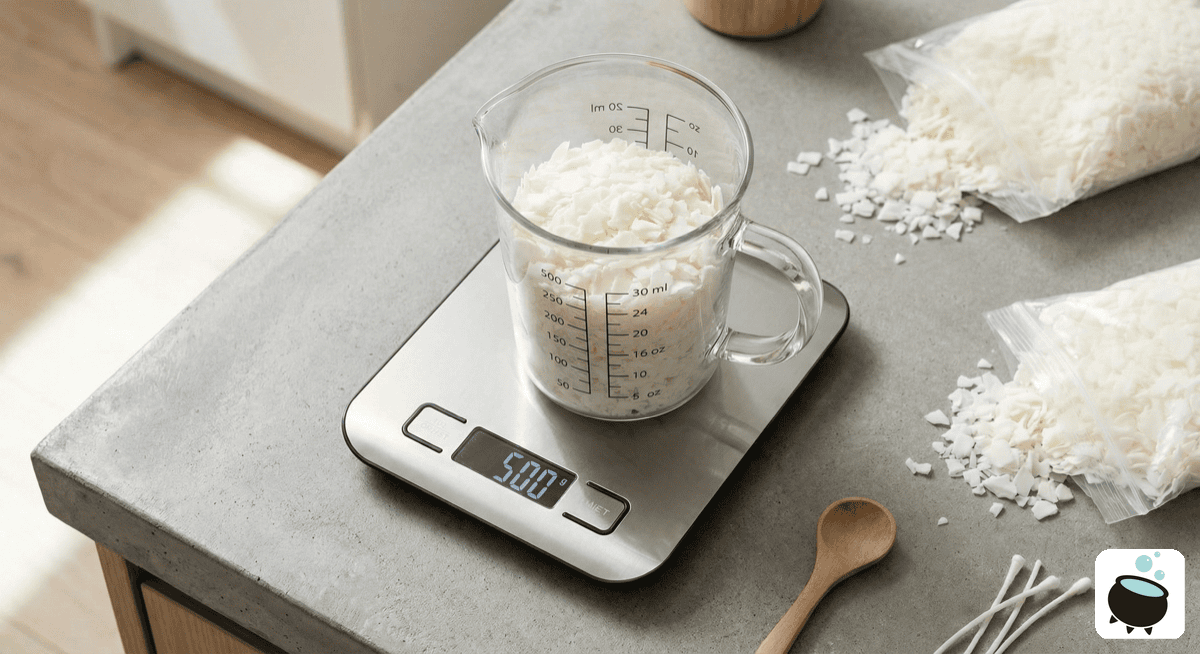
Buying Wax in Bulk
How Much to Order
Calculate your production needs:
Monthly Wax = (Wax per candle × Candles per month) × 1.15
Example: 50 candles/month in 8 oz jars
- Per candle: 6.9 oz
- Monthly: 6.9 × 50 = 345 oz
- With buffer: 345 × 1.15 = 397 oz ≈ 25 lbs
Converting Pounds to Candles
Work backward to know production capacity:
Candles possible = (Wax in lbs × 16) ÷ (Wax per candle × 1.10)
Example: 10 lbs soy wax, 8 oz containers
- 10 lbs = 160 oz
- Per candle (with waste): 6.9 × 1.10 = 7.59 oz
- Candles possible: 160 ÷ 7.59 = 21 candles
Frequently Asked Questions
How many candles can I make with 10 pounds of wax?
Depends on container size. With 8 oz containers and soy wax: 10 lbs ÷ (6.9 oz per candle × 1.1 waste factor) = about 21 candles. Smaller containers yield more candles per pound.
Why do my candles have air pockets even with correct wax amount?
Air pockets (sinkholes) form during cooling, not from incorrect measurement. Pour at proper temperature, use a heat gun or second pour to fix, and consider additives that reduce sinkholes.
Should I weigh wax or measure by volume?
Always weigh. Volume measurements are inaccurate because wax doesn't pack consistently. Use a digital scale for precision.
How do I calculate wax for pillar candles without containers?
Use mold dimensions to calculate volume, then apply the same conversion factors. Add extra for unmolding waste and imperfect tops.
Does wax shrink when cooling?
Yes, slightly. This causes sinkholes and minor volume reduction. The 10% buffer in calculations accounts for this.
Can I reuse leftover wax from my pour pot?
Yes, save it for future batches. Track what fragrance was in it if scented, as residue can affect future candles.
Conclusion
Accurate wax calculation eliminates guesswork from candle making. Know your container volume, apply the correct conversion factor for your wax type, add margin for waste, and scale for batch production.
For candle businesses making multiple products and batch sizes, dedicated software can automatically calculate wax requirements across all your container types and production volumes.
Whether you're making a single test candle or planning a 100-unit production run, precise calculations mean consistent quality and efficient material use.
Ready to Manage Your Recipes Like a Pro?
PotionHub helps soap and candle makers calculate lye, track batches, manage inventory, and grow their business.
Get PotionHub