Soap Mold Sizes: How Much Soap Do You Need for Your Mold?
Calculate exactly how much soap batter you need for any mold size. Includes volume formulas, common mold dimensions, and a quick reference chart for popular soap molds.
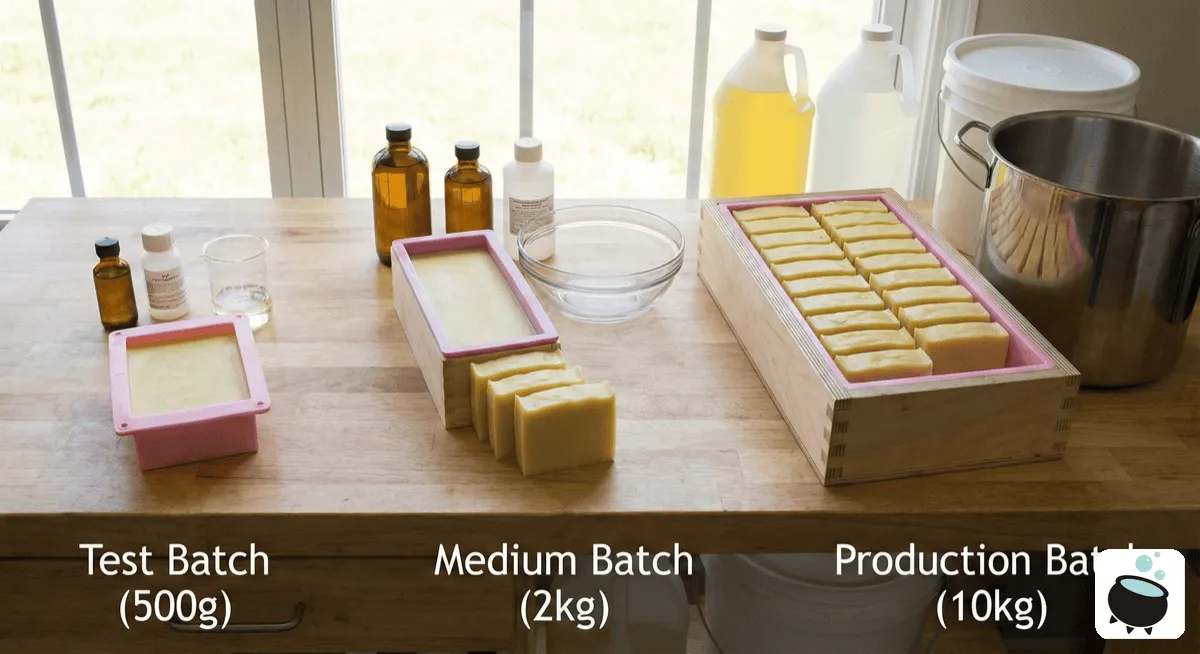
Quick Answer
The simplest formula for calculating how much soap oil you need for any mold is:
Oil Weight (oz) = Mold Volume (cubic inches) × 0.4
This accounts for the density of soap batter and gives you a reliable starting point. For precise formulations, use our free lye calculator which will adjust for your chosen superfat percentage and lye concentration.

Why Mold Size Matters
Getting the mold size right is one of the most critical decisions in soap making. Too small a mold and you'll waste precious ingredients by overfilling; too large and you'll end up with thin bars that crack or don't set properly. Professional soap makers know that mold selection directly impacts:
- Production efficiency: The right mold reduces waste and increases output per batch
- Curing time: Proper thickness ensures even moisture distribution during cure
- Bar appearance: Consistent mold sizing means predictable bar dimensions and professional presentation
- Cost per bar: Optimal use of materials reduces per-unit production costs
- Safety: Molds that are too deep create concentration issues with heat generation
Understanding mold volumes allows you to scale recipes, maintain consistency across batches, and plan your production workflow with confidence.
How to Calculate Mold Volume
Different mold shapes require different formulas. Here's how to measure and calculate the volume of any mold you're considering:
Rectangular Molds
Rectangular loaf molds are the most common choice for soap making.
Formula: Volume = Length × Width × Height (all in inches)
Example: A standard loaf mold measuring 12" × 3.5" × 3.25" has:
- Volume = 12 × 3.5 × 3.25 = 136.5 cubic inches
- Oil needed = 136.5 × 0.4 = 54.6 oz of oils
Cylindrical Molds
Round silicone or PVC molds require a different calculation.
Formula: Volume = π × r² × h
- Where r = radius (diameter ÷ 2) and h = height (all in inches)
- Simplified: Volume = 3.14159 × (diameter ÷ 2)² × height
Example: A cylindrical mold with 4" diameter and 6" height:
- Radius = 2 inches
- Volume = 3.14159 × 4 × 6 = 75.4 cubic inches
- Oil needed = 75.4 × 0.4 = 30.2 oz of oils
Irregular or Multi-Cavity Molds
For silicone molds with artistic shapes, measure by displacement:
- Fill a measuring container (in cubic inches) with water
- Place the empty mold cavity in the container
- Fill with water until level with the mold rim
- The difference is your cavity volume
- Multiply by the number of cavities for total volume
Alternatively, if the mold weight is known, weigh the mold and subtract that from its total weight when filled with water. The weight difference in grams equals the volume in milliliters, which converts to cubic inches (1 cubic inch = 16.387 mL).
Common Soap Mold Sizes
This reference table covers the most popular mold configurations used by soap makers, from hobbyists to commercial producers:
| Mold Type | Dimensions | Volume (cu in) | Oil Weight (oz) | Bars Produced |
|---|---|---|---|---|
| Small Loaf | 8" × 2.5" × 2.5" | 50 | 20 | 8-10 |
| Standard Loaf | 12" × 3.5" × 3.25" | 136.5 | 54.6 | 12-15 |
| Large Loaf | 14" × 4.5" × 4.5" | 283.5 | 113.4 | 20-24 |
| 2 lb Slab | 10" × 5" × 3" | 150 | 60 | 12-14 |
| 5 lb Slab | 12" × 10" × 4" | 480 | 192 | 30-35 |
| Individual Round (2" dia) | 2" diameter, 3" height | 9.4 | 3.8 | 1 |
| Individual Square (2" × 2") | 2" × 2" × 3" | 12 | 4.8 | 1 |
| Silicone 6-Cavity | 8.5" × 5.5" × 2.5" each | 45 × 6 = 270 | 108 | 6 (if 4oz each) |
| Silicone 9-Cavity | 10" × 6" × 2" each | 40 × 9 = 360 | 144 | 9 (if 4oz each) |
| PVC Pipe (4" dia, 6" tall) | 4" diameter | 75.4 | 30.2 | 4-6 |
Converting Volume to Oil Weight
The 0.4 oz per cubic inch rule is derived from the density of soap batter in its pre-cure state. This number accounts for:
- The volume taken up by the lye solution
- The volume of fragrance and additives
- Natural compression as batter is poured
- Air pockets that form during setting
Why 0.4 oz per Cubic Inch?
When measuring pure oils (before mixing with lye solution), the average density of soap oils is approximately 0.92 oz per cubic inch. However, when combined with the lye solution (which is lighter), fragrance, and colorants, the overall batter density decreases to roughly 0.4 oz of base oils per cubic inch of final batter volume.
Worked Examples
Example 1: Standard Loaf Batch
- Mold volume: 136.5 cubic inches
- Oil weight = 136.5 × 0.4 = 54.6 oz
- At 38% lye concentration: 54.6 × 0.383 = 20.9 oz lye needed
- At 5% superfat: 54.6 × 0.95 = 51.87 oz oils in final recipe
Example 2: Individual Cavity Mold
- Each cavity volume: 12 cubic inches (2" × 2" × 3")
- Oil weight per bar = 12 × 0.4 = 4.8 oz
- At 38% lye concentration: 4.8 × 0.383 = 1.84 oz lye
- Perfect for testing new colorant combinations
Example 3: Large Production Batch
- 5 lb slab mold: 480 cubic inches
- Oil weight = 480 × 0.4 = 192 oz
- That's 192 ÷ 16 = 12 lbs of oils
- At standard ratios: 4.6 lbs lye solution needed
Popular Mold Brands Reference
This table shows specifications for commonly available commercial soap molds:
| Brand/Model | Dimensions | Volume (cu in) | Batch Size | Notes |
|---|---|---|---|---|
| Milliard Silicone 15-Cavity | 13.5" × 8" × 1.5" each | 35 × 15 = 525 | ~4oz per bar | Great for retail-size bars |
| Natursoapmolds Wooden Loaf | 12" × 3.5" × 3.25" | 136.5 | 54.6 oz oils | Liner included |
| Envirocare Slab (2lb) | 9" × 6" × 3" | 162 | 64.8 oz oils | Professional grade |
| Hustar Silicone Roses | 2.5" dia, 3.25" tall | 15.9 × 6 = 95.4 | 10-12 oz oils | High-end aesthetic |
| AAA & Co. Cold Saponification | 10" × 5" × 5" | 250 | 100 oz oils | Deep cavity for thick soap |
| Nurture Soap Making 9-Bar | 10.5" × 5.5" × 2.5" | 144 | 57.6 oz oils | Individual cavity separation |
| Wooden PVC Pipe Liner | Various | 75.4 (4" pipe) | 30.2 oz oils | Highly customizable |
| Crafter's Choice Individual | 1.5" × 1.5" × 3" | 6.75 × 12 = 81 | 4.8-6 oz each | Perfect for gift sets |
Choosing the Right Mold Size for Your Business
The decision between different mold sizes depends on your production goals, workspace, and market:
For Hobbyists
Individual cavity molds (2" × 2" or round 2" diameter) are ideal. They produce 4-6 oz bars perfect for testing new recipes without committing large quantities of oils. You maintain experimentation freedom while minimizing waste.
For Small Home Businesses
Standard loaf molds (12" × 3.5" × 3.25") offer the sweet spot. They produce 12-15 bars per batch using 54.6 oz of oils, manageable for home equipment while generating respectable production numbers. Batch preparation time stays under 30 minutes, and curing doesn't require excessive space.
For Mid-Size Production
Multiple loaf molds or slab molds (2-5 lbs) allow you to run 2-3 batches per production day. A 5 lb slab at 192 oz of oils produces 30-35 bars, scaling output without proportionally scaling preparation complexity. This is the range where unit economics begin to favor wholesale operations.
For Commercial Operations
Large slab or custom molds paired with cutting equipment become cost-effective. At 300+ oz per batch, per-unit material costs drop significantly. Professional-grade PVC pipe systems or insulated wooden molds maintain cure temperature consistency, critical for large volumes.
Space Constraints
If your workspace is limited, deeper molds (4-5" height) in smaller footprint reduce floor requirements. A 10" × 5" × 5" mold uses only 50 square inches of surface area while holding 250 cubic inches of batter.
Aesthetic Goals
Decorative silicone molds produce visually distinctive bars commanding premium pricing, but accept larger oil quantities per batch (120-150 oz typically). The investment in specialty molds pays off only if your market values design enough to support higher material costs.
Common Sizing Mistakes
Mistake 1: Overfilling Molds
The most frequent error is filling molds beyond capacity. This causes:
- Batter overflow during gel phase expansion
- Uneven top surface requiring excessive trimming
- Structural failure if batter overflows during unmolding
Solution: Fill to 90% capacity, leaving half-inch headroom for expansion.
Mistake 2: Underestimating Total Recipe Volume
Forgetting to account for the lye solution volume in your oil measurement leads to recipes that are too weak or won't reach mold capacity.
Solution: Use our formula correctly—the 0.4 multiplier already accounts for full batter volume.
Mistake 3: Using Old Density Assumptions
Some outdated resources use 0.5 oz per cubic inch or 0.3 oz per cubic inch. These lead to batches that are consistently over or undersized.
Solution: Always verify with your specific recipe oils (coconut, palm, and olive oils have slightly different densities) using the free lye calculator.
Mistake 4: Not Accounting for Fragrance Loss
Fragrance oil takes volume in your mold but isn't heavy enough to offset its volume. If you're adding 0.5 oz of fragrance per pound of oils, you're losing ~2-3% of effective density.
Solution: Reduce oil weight by 1% when using heavy fragrance loads (over 0.7 oz per pound).
Mistake 5: Ignoring Mold Material Differences
Silicone molds require different pouring viscosity than wooden molds. Thin silicone pours may result in incomplete fill of detailed cavities.
Solution: Use accelerating additives (salt, sodium lactate) only when necessary, and prioritize proper pouring temperature management.
Mistake 6: Not Testing Before Large Production
Attempting to scale directly from a tested loaf mold size to five times that volume often fails due to different curing dynamics in larger masses.
Solution: Always test a new mold size at half or third the intended production volume first.
Frequently Asked Questions
How much does the type of oil blend affect mold volume calculation?
The 0.4 oz per cubic inch rule works across all typical soap oil blends. Whether you're using palm, coconut, olive, avocado, or specialty oils, the batter density remains remarkably consistent at approximately 0.4 oz per cubic inch when combined with water-based lye solution. If you're adding unusual additives like titanium dioxide at high concentrations (10%+ by weight), density may shift slightly, but the variation is typically less than 5%.
Can I use the same mold for both hot process and cold process soap?
Yes. Both methods use the same volume-to-oil calculations. However, hot process soap may require slightly less space due to water evaporation during cooking. If making both types, calculate for cold process (the more conservative approach) to avoid overflow during hot process.
What's the minimum and maximum oil weight for a single batch?
For cold process soap, you need at least 12 oz of base oils to generate sufficient heat for gel phase. Below this, your batch may not gel and could result in dreaded false trace. The maximum is limited only by your mold size and workspace—many commercial operations run batches exceeding 50 lbs of oils. For home use, 50-100 oz per batch offers optimal balance between production efficiency and manageability.
How do I calculate volume for molds with cavities that vary in size?
Measure each cavity individually using the water displacement method, then add the volumes together. Some decorative molds have cavities ranging from 8 cubic inches to 20 cubic inches in a single mold. Total volume determines your batch size, but you'll need different oil weights for each cavity type if pouring individually.
Should I reduce my oil amount if I'm adding lots of fragrance or colorants?
For typical usage (fragrance at 0.7 oz per pound of oils, colorants under 1% by weight), the adjustment is negligible—less than 2-3% variation. However, if you're experimenting with extremely high fragrance loads or unusual additives, reduce your base oil amount by the weight of additives. The 0.4 multiplier assumes pure oils as your base.
What volume should I use for calculating a swirl batch if I'm splitting colors?
Calculate your total mold volume normally, then divide the batch proportionally. If your mold is 150 cubic inches (60 oz oils) and you want equal swirls in three colors, each color gets 50 oz. You'll still prepare the full batch of lye solution and oils, then divide before adding color.
Can I use household measuring tools instead of calculating by volume?
Technically yes, but it's imprecise. A standard measuring cup (8 oz) is 14.4 cubic inches. You could fill your mold with water and measure it in cups, then multiply by 0.4 × (number of cups). However, this introduces rounding errors. Digital kitchen scales measuring grams converted to cubic inches (1 gram water = 0.061 cubic inches) are more accurate if you don't have proper measuring tools.
What happens if my mold is slightly larger than my calculated batch?
Underfilling a mold by 5-10% typically causes no problems. The soap will still cure normally, though it may not perfectly fill all cavities (visible at bars' sides). If you're consistently underfilling, choose a smaller mold next time. Underfilling by more than 15% can result in slower gel phase and uneven curing.
Conclusion
Mastering mold size calculations transforms soap making from guesswork into precision production. The simple formula—oil weight in ounces equals mold volume in cubic inches times 0.4—works across all typical scenarios and mold types.
Start by measuring your current mold accurately, calculate the optimal batch size, and use our free lye calculator to build a recipe that perfectly fills it. As you work with different mold sizes and oil blends, you'll develop intuition for volume-to-batch relationships. This knowledge becomes invaluable when scaling production, experimenting with new mold shapes, or troubleshooting batches that aren't performing as expected.
Whether you're producing 12 bars per week for friends or shipping hundreds monthly to retailers, the foundation is the same: understand your mold volume, calculate correctly, and maintain consistency across batches. That's how good soap makers become great ones.
Try These Free Tools
Skip the Manual Math
PotionHub calculates lye, tracks batches, manages inventory, and scales recipes for you. Free during beta — no credit card required.
Get PotionHub Free