Soy Candle Making Guide: Temperatures, Fragrance Loads & Common Mistakes
Complete soy candle making guide covering wax types (464 vs 444), pour temperatures, fragrance load percentages, curing times, troubleshooting, and how to avoid 10 common mistakes.
Quick Answer
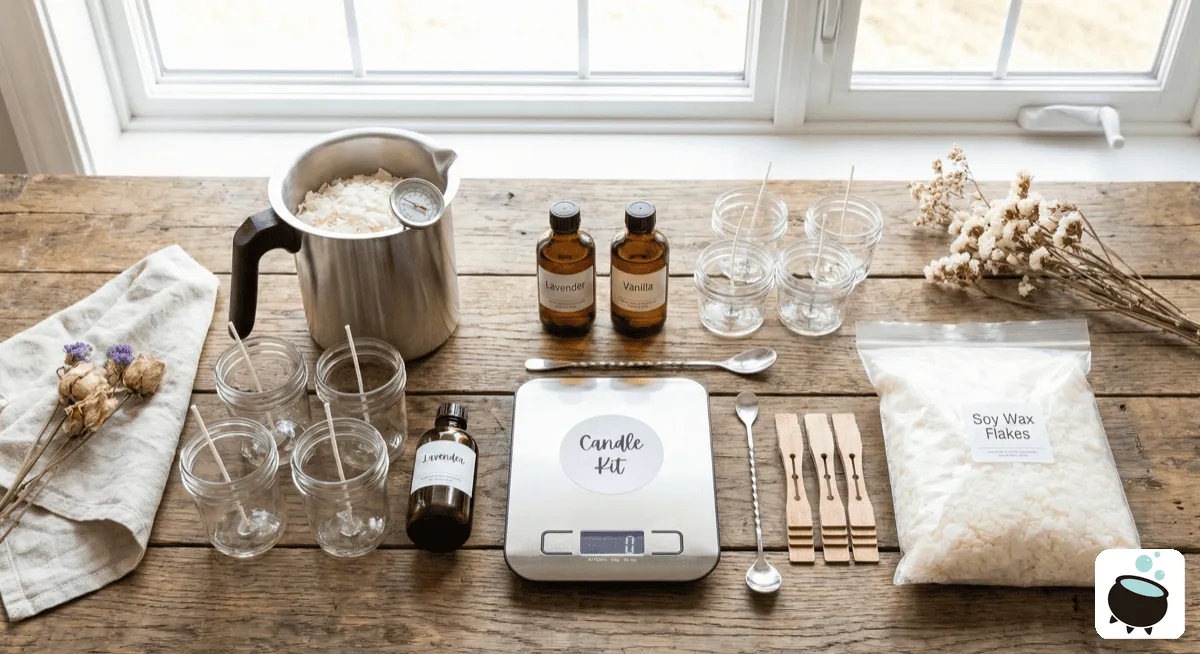
Soy candles are poured at 170-180°F into containers at 70-80°F. Use 464 wax for containers, 444 for pillars. Fragrance load is 6-10% of wax weight (add at 180-200°F). Let candles cure 24-48 hours before burning. Common mistakes: pouring too hot (frosting), too much fragrance (doesn't cure), wrong wick size (tunneling), and skipping cure time. Use PotionHub's free candle wax calculator to measure exact amounts.
Free Candle Wax Calculator
Calculate exact wax amounts for any container size, instantly. Account for wick weight and get precise measurements every time.
Free Candle Fragrance Calculator
Calculate fragrance load percentages automatically. Ensure you're never over-fragrancing or under-scenting your candles.

Why Soy Wax for Candle Making?
Many beginning candle makers ask: should I use soy, paraffin, or blended wax? Soy has major advantages:
- Natural and renewable - Made from soybean oil
- Burns longer - 30-50% longer burn time than paraffin
- Cleaner burn - Less soot, better for indoor air quality
- Takes fragrance well - 6-10% fragrance load possible
- Better scent throw - Fragrance disperses throughout room
- Biodegradable - Easy cleanup, environmentally friendly
- Premium image - Customers pay more for soy candles
The downside? Soy wax is more temperamental than paraffin. It requires specific temperatures, needs curing time, and fragrance can cause frosting if you're not careful. But once you understand soy, you'll create candles that perform beautifully.
Soy Wax Types: 464 vs 444
The two most common soy waxes are different. Choose the right one:
Soy Wax 464
Best for: Container candles (jars, tins, vessels)
| Feature | Details |
|---|---|
| Pour temperature | 170-180°F |
| Melt point | 120-130°F |
| Working time | 20-30 minutes |
| Fragrance load | 6-8% |
| Curing time | 24-48 hours |
| Container strength | Excellent adhesion |
| Frosting tendency | Moderate (fixable) |
Soy Wax 444
Best for: Pillar candles, blended shapes, specialty containers
| Feature | Details |
|---|---|
| Pour temperature | 160-170°F |
| Melt point | 130-140°F |
| Working time | 15-20 minutes |
| Fragrance load | 6-9% |
| Curing time | 48-72 hours |
| Container strength | Good adhesion |
| Frosting tendency | Higher than 464 |
For beginners: Use 464 wax. It adheres better to jars, is more forgiving, and is easier to work with.
Soy Candle Melting and Temperature Control
Temperature is critical with soy wax. Too hot and you get frosting; too cool and fragrance won't incorporate properly.
The Right Way to Melt Soy Wax
Never: Melt soy wax directly on heat or in direct flame. The high heat damages the wax and burns fragrance.
Always: Use a double boiler (water bath) method:
- Fill bottom pot with water - About 3 inches deep
- Place smaller pot/container in water - Wax sits in upper container
- Heat water to gentle simmer - Not boiling, gentle bubbles
- Stir wax occasionally - Check temperature with thermometer
- Remove when fully melted - When reaching target temperature
Temperature Targets
| Stage | Temperature | What to Do |
|---|---|---|
| Melting | 160-180°F | Slowly melt in double boiler |
| Cooled slightly | 180-190°F | Ready to add fragrance |
| For pouring | 170-180°F | Pour into containers |
| Container temp | 70-80°F | Containers should be room temp |
Preventing Overheating
- Use thermometer constantly,don't guess
- Remove wax from heat before fully melted; residual heat finishes the job
- Keep water in bottom pot simmering, not boiling
- Never let soy wax exceed 185°F
Adding Fragrance to Soy Wax
Fragrance is where beginners often struggle. Too much causes problems; too little wastes potential.
Fragrance Load Percentages
Fragrance load = weight of fragrance as percentage of wax weight
| Load Level | Percentage | Pour Temp | Result |
|---|---|---|---|
| Light | 3-5% | 170°F | Subtle scent, very clean burn |
| Medium | 6-7% | 180°F | Balanced scent, good performance |
| Strong | 8-10% | 185°F | Strong scent, needs careful temp |
| Over-fragranced | 10%+ | Risky | Likely to frost, wet spots, dull spots |
Best practice for beginners: Start at 6% fragrance load. This provides good scent throw without most temperature problems.
How to Calculate Fragrance Amount
Formula: Wax weight × fragrance percentage = fragrance ounces
Example: 1 lb soy wax (16 oz) × 6% = 0.96 oz fragrance
| Wax Amount | At 6% Load | At 8% Load | At 10% Load |
|---|---|---|---|
| 8 oz (small) | 0.48 oz | 0.64 oz | 0.8 oz |
| 16 oz (medium) | 0.96 oz | 1.28 oz | 1.6 oz |
| 24 oz (large) | 1.44 oz | 1.92 oz | 2.4 oz |
| 32 oz (very large) | 1.92 oz | 2.56 oz | 3.2 oz |
Use PotionHub's free candle fragrance calculator to do this instantly.
When and How to Add Fragrance
Step 1: Heat wax to 180-185°F
Step 2: Remove from heat and let cool 2-3 minutes
Step 3: Add fragrance oil,stir slowly for 30-60 seconds (don't vigorous stir, introduce air bubbles)
Step 4: Wait 3-5 minutes
Step 5: Stir again slowly for 30 seconds
Step 6: Check temperature is still 170-180°F and pour
Timing note: The waiting period allows fragrance to integrate properly. Pouring immediately can cause frosting.
Fragrance Oil vs. Essential Oil
| Type | Best For | Notes |
|---|---|---|
| Fragrance Oil | Soy candles | Designed for candles, better scent throw, heat stable |
| Essential Oil | Specialty only | Burns off quickly, unsuitable for candles unless blended for display |
Use fragrance oils formulated for candles. Essential oils are too volatile and expensive for this purpose.
Container Selection and Prep
Your container choice affects final candle quality.
Best Containers for Soy Candles
| Container Type | Compatibility | Tips |
|---|---|---|
| Soy-friendly jars | Excellent | Apothecary jars, mason jars |
| Votive holders | Excellent | 2-3 oz perfect starter size |
| Tin containers | Excellent | Popular for gift sets |
| Pillar molds | Good (464 wax) | Requires reinforced wick |
| Repurposed jars | Good | Vintage glass works great |
| Paraffin-only containers | Risky | May not adhere properly |
Prepping Containers
Temperature is key: Containers should be room temperature (70-80°F) when you pour.
Warm containers? Cold soy wax poured into warm containers causes thermal shock and frosting.
Wick attachment:
- Use wick stickers on metal tabs
- Center wick in container bottom
- Let sticker set before adding wax
Pre-warming? Don't. Cold containers help soy cure without frosting.

Complete Soy Candle Making Process
Materials Needed
For a single 8 oz candle:
| Item | Amount |
|---|---|
| Soy wax 464 | 8 oz (227 g) |
| Fragrance oil | 0.48 oz (13.6 g) - for 6% load |
| Wick (CD 51 for 2.5-3" jar) | 1 wick |
| Container | 8 oz jar |
| Wick sticker | 1 per candle |
Step-by-Step Process
Step 1: Prep containers and wicks
- Place wick sticker in center of jar bottom
- Press wick tab down firmly
- Let sticker dry 1 minute
Step 2: Measure wax
- Weigh soy wax on digital scale: 8 oz
- Place in double boiler
Step 3: Melt wax
- Heat water bath to gentle simmer
- Stir wax every 2 minutes
- Remove from heat when fully melted at ~180°F
Step 4: Add fragrance
- Let wax cool 2-3 minutes
- Add 0.48 oz fragrance oil
- Stir slowly for 30-60 seconds
Step 5: Wait and stir again
- Wait 3-5 minutes
- Stir again slowly for 30 seconds
- Check temperature (should be 170-180°F)
Step 6: Pour candle
- Carefully pour wax into container, centered around wick
- Leave 0.5 inch at top
- Work steadily,soy wax hardens as it cools
Step 7: Wick centering
- If wick moves, adjust while wax is still soft
- Use clothespin or wick holder to keep centered
Step 8: Cool naturally
- Let candle sit at room temperature
- Don't move or disturb
- Wax will harden over 1-2 hours
Step 9: Trim wick
- Once hardened, trim wick to 1/4 inch
Step 10: Cure time
- Wait 24-48 hours before burning (or 48-72 hours for 444 wax)
- Curing allows fragrance to cure properly and wax to fully set
What You Should See
Good result:
- Smooth, opaque surface
- Wick centered
- No visible sinkhole or crater
- Slight fragrance scent (not overpowering)
- Wax adhered to sides of container
Frosted surface? See troubleshooting below.
Common Soy Candle Problems and Solutions
Problem 1: Frosting (White Crystals on Surface)
What it is: Wax crystals forming on surface. Purely cosmetic,candle still burns fine.
| Cause | Solution | Prevention |
|---|---|---|
| Poured too hot | Heat gun or torch to smooth | Pour at 170-180°F exactly |
| Temperature shock | Reheat container and re-pour | Keep containers at room temp |
| Over-fragranced | Too late to fix | Use 6-8% fragrance load |
| Cooling too fast | Wrap candle in blanket | Let cool naturally, indoors |
To fix existing frosting:
- Use heat gun on low, move slowly over surface
- Wax will briefly melt and smooth out
- Let cool naturally
Problem 2: Wet Spots (Gaps Between Wax and Container)
What it is: Wax pulled away from container sides as it cooled.
| Cause | Solution | Prevention |
|---|---|---|
| Poured too hot | Reheat surface gently | Pour at 170-180°F |
| Cooled too fast | Wrap to insulate while cooling | Cool naturally indoors |
| Wrong wick size | Use PotionHub calculator | Test wick size before full batch |
| Too much fragrance | Can't fix | Use 6-8% fragrance load |
Wet spots eventually improve as candle cures, but not always completely.
Problem 3: Sinkholes (Crater in Middle)
What it is: Large crater forms in center as wax cools.
| Cause | Solution | Prevention |
|---|---|---|
| Normal cooling | Pouring technique won't help | Cure longer,24-48 hours |
| Thick-walled candles | May need second pour | Pour slower to allow even cooling |
Minor sinkholes are normal and don't affect burn quality. Some candle makers do a "top-up pour" 12 hours after the first pour,pour a small amount of melted wax at 180°F to fill cracks. This is optional.
Problem 4: Weak Scent Throw
What it is: Candle doesn't smell as strong as expected.
| Cause | Solution | Prevention |
|---|---|---|
| Not cured yet | Wait 24-48 hours; scent improves | Allow proper cure time |
| Fragrance too light | Use stronger fragrance | Choose fragrances known for throw |
| Low fragrance load | Can't fix burning candle | Use 8% fragrance for stronger scent |
| Poor quality fragrance | Replace fragrance supplier | Source from candle-specific suppliers |
Note: Scent throw improves significantly after 24-48 hour cure.
Problem 5: Wick Drowning (Flame goes out)
What it is: Wick is surrounded by liquid wax and won't stay lit.
| Cause | Solution |
|---|---|
| Wick too small | Burn a second or third time,melt pool should eventually consume outer wax and expose wick |
| Container too deep | Use smaller wick next batch |
| Too much fragrance | Use 6-7% instead of 10% |
Prevention: Use PotionHub's free wick calculator to match wick to container.
Problem 6: Wick Mushrooming (Large carbon buildup)
What it is: Dark mushroom-shaped carbon ball forms on wick tip during burn.
| Cause | Solution |
|---|---|
| Wick too large | Trim wick to 1/4 inch before next burn |
| Fragrance causes excess smoke | Use lower fragrance load (6% instead of 8%) |
Always trim wick to 1/4 inch before each burn.
Temperature Troubleshooting Chart
| Problem | Temperature | Fix |
|---|---|---|
| Won't fully melt | Too cool | Increase heat gradually |
| Fragrance won't incorporate | Too cool when fragrance added | Heat to 180°F before adding |
| Frosting occurs | Too hot or temperature shock | Pour at 170-180°F into room temp containers |
| Wax hardens too quickly | Pouring too cool | Increase to 175-180°F at pour |
| Wet spots appear | Uneven cooling | Pour steady, let cool naturally indoors |
Multi-Wick Soy Candles
For larger containers (4" diameter+), multiple smaller wicks often work better than one large wick:
When to Use Multiple Wicks
| Container Diameter | Single Wick | Multi-Wick |
|---|---|---|
| Up to 3.5" | Yes | Not necessary |
| 3.5 - 4.5" | Optional | Better option |
| 4.5" - 5.5" | Difficult | Preferred |
| 5.5"+ | Not recommended | Required |
Multi-Wick Setup
- Space wicks evenly (equal distance apart)
- Use 3 smaller wicks instead of 1 giant wick
- Example: 4" container = 3 × CD 51 wicks better than 1 × CD 109
- Use wick stickers to keep them centered
Advantages
- More even melt pool
- Better fragrance distribution
- Cooler burn (less soot)
- More visually interesting
Curing: Why It Matters
You've waited to pour your candle at the right temperature. Now wait for it to cure properly.
What Happens During Cure
- Wax fully solidifies (4-6 hours)
- Fragrance cures (bonds with wax molecules)
- Melt pool sets (prevents tunneling on first burn)
- Scent throw maximizes (24-48 hours)
Minimum Cure Times
| Wax | Minimum | Optimal |
|---|---|---|
| Soy 464 | 24 hours | 48 hours |
| Soy 444 | 48 hours | 72 hours |
Don't skip curing. A candle burned uncured performs poorly and disappoints customers.
10 Common Mistakes Beginners Make
- Pouring too hot - Causes frosting and wet spots. Pour at 170-180°F.
- Using paraffin-only containers - Soy may not adhere. Use soy-compatible jars.
- Over-fragrancing - More than 10% causes problems. Use 6-8%.
- Adding fragrance at wrong temp - Add at 180-185°F, wait, then stir. Don't add to barely-melted wax.
- Wrong wick size - Test with small batches first. Use PotionHub's calculator.
- Skipping cure time - A 24-48 hour wait improves scent throw significantly.
- Burning uncured candles - Always wait 24-48 hours minimum.
- Not trimming wicks - Trim to 1/4 inch before each burn.
- Using essential oils - Essential oils are too volatile. Use fragrance oils.
- Impatient temperature management - Temperature is critical with soy. Use thermometer constantly, don't guess.
Frequently Asked Questions
Can I blend soy with paraffin wax?
Yes, 50/50 blends are common and offer benefits of both. However, this changes fragrance load and wick requirements. Start with 100% soy while learning.
Why is my soy wax so soft?
Soy melts at lower temperatures than paraffin. This is normal. If candles are too soft after 48 hours cure, your fragrance load might be too high or room temperature too warm.
Can I use the same wick for soy and paraffin?
No. Soy generally uses smaller wicks than paraffin of the same container size. Always test with the wax type you're using.
How long do soy candles burn?
Soy burns 30-50% longer than paraffin. An 8 oz soy container candle burns 40-50 hours. Paraffin equivalent burns 25-35 hours.
Is soy wax expensive?
Soy costs 20-30% more than paraffin per pound. However, longer burn time offsets this for end-user cost.
Can I pour soy into any container?
Soy adheres best to glass and metal. Some plastics work but aren't ideal. Test small batches first.
What's the best fragrance load?
6-7% is a sweet spot for scent throw without frosting issues. 8% is stronger but riskier. Avoid exceeding 10%.
Why does my candle smell weak after burning for 20 minutes?
Your nose adjusted to the scent (olfactory fatigue). The candle is working. Guests will smell it strongly.
Conclusion
Soy candle making requires attention to temperature, fragrance load, and cure time. Master these three variables and you'll create beautiful, long-burning candles that customers love.
Start with 464 wax in small 8 oz containers. Follow the temperature guidelines strictly,170-180°F for pouring, fragrance added at 180-185°F, containers at room temperature. Use 6% fragrance load initially. Always cure 24-48 hours before burning.
Track your batches with detailed notes. When something goes wrong, troubleshoot systematically,most problems trace to temperature management or fragrance load. PotionHub's free candle calculators remove the guesswork from wax amounts and fragrance percentages, letting you focus on mastering technique.
With practice, soy candle making becomes intuitive. Your candles will burn clean, smell beautiful, and last longer than paraffin alternatives. That's worth the learning curve.
Try These Free Tools
Skip the Manual Math
PotionHub calculates lye, tracks batches, manages inventory, and scales recipes for you. Free during beta - no credit card required.
Get PotionHub Free