SAP Values Explained: The Complete Guide for Soap Makers
Understand SAP values for soap making. Learn what saponification values mean, how to use them for lye calculations, and find SAP values for common oils and butters.
Quick Answer
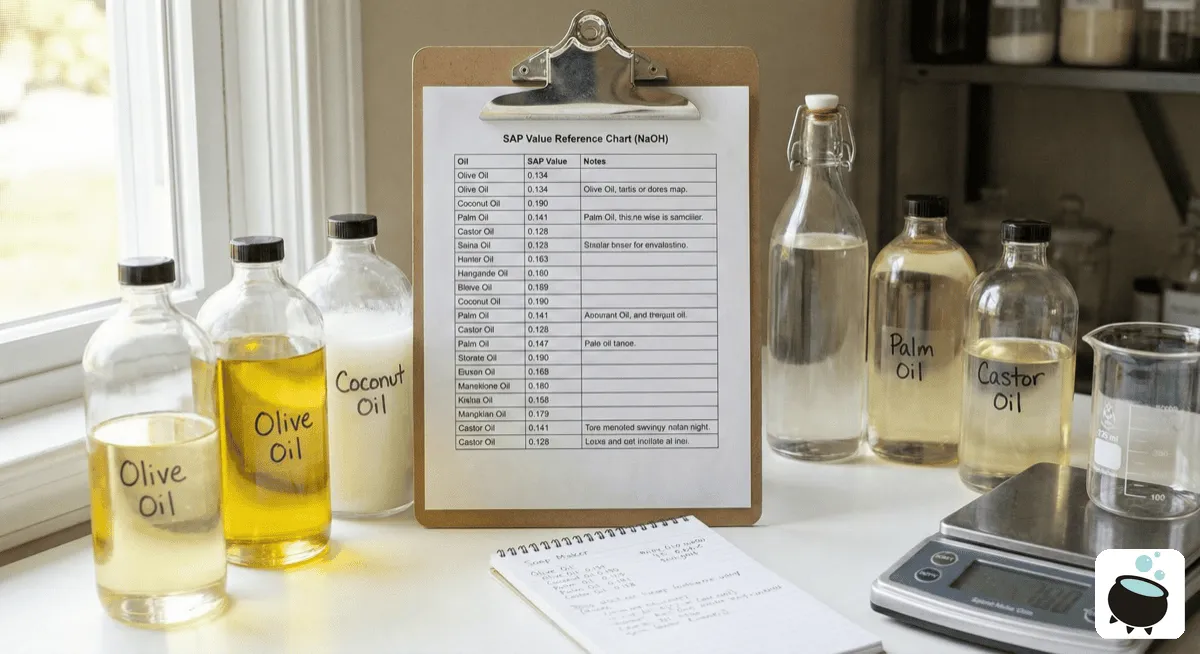
SAP (saponification) value tells you how much lye is needed to convert a specific oil into soap. For sodium hydroxide soap: multiply oil weight by its NaOH SAP value. Example: 16 oz olive oil × 0.134 = 2.14 oz lye needed. Every oil has a unique SAP value based on its fatty acid composition.
What Is a SAP Value?
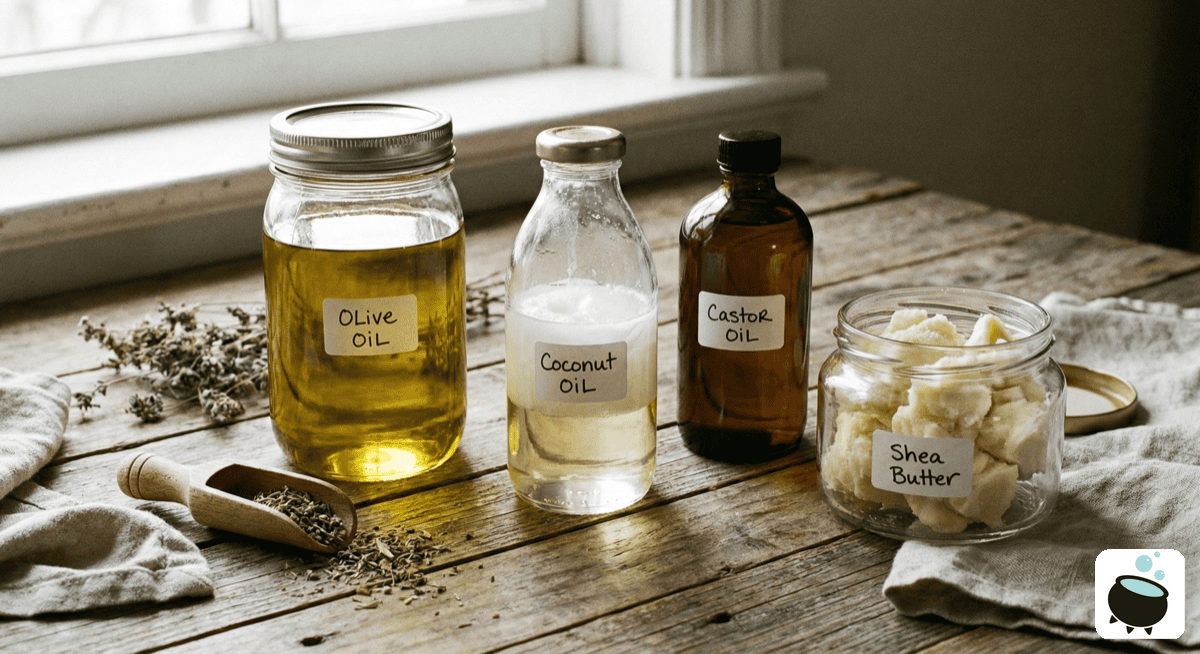
SAP value (saponification value) is a number that represents how much alkali (lye) is required to saponify a specific amount of oil or fat. Different oils have different fatty acid compositions, so they require different amounts of lye. Learn how to use these values in our complete lye calculation guide.
The chemistry: Oils are made of triglycerides (fatty acid chains attached to glycerin). Lye breaks these bonds, freeing the glycerin and converting fatty acids into soap. Different fatty acids require different amounts of lye.
Types of SAP Values
NaOH SAP Value (Sodium Hydroxide)
Used for: Bar soap (cold process, hot process)
This tells you ounces of sodium hydroxide needed per ounce of oil.
Example: Olive oil NaOH SAP = 0.134
- 1 oz olive oil needs 0.134 oz sodium hydroxide
KOH SAP Value (Potassium Hydroxide)
Used for: Liquid soap, cream soap
This tells you ounces of potassium hydroxide needed per ounce of oil.
Example: Olive oil KOH SAP = 0.188
- 1 oz olive oil needs 0.188 oz potassium hydroxide
Converting Between NaOH and KOH
KOH SAP = NaOH SAP × 1.403
NaOH SAP = KOH SAP × 0.713
Complete SAP Value Reference Table
Vegetable Oils
| Oil | NaOH SAP | KOH SAP |
|---|---|---|
| Almond Oil, Sweet | 0.136 | 0.191 |
| Apricot Kernel Oil | 0.135 | 0.189 |
| Avocado Oil | 0.133 | 0.187 |
| Canola Oil | 0.124 | 0.174 |
| Castor Oil | 0.128 | 0.180 |
| Coconut Oil (76 degrees) | 0.178 | 0.250 |
| Coconut Oil (92 degrees) | 0.170 | 0.239 |
| Corn Oil | 0.136 | 0.191 |
| Cottonseed Oil | 0.138 | 0.194 |
| Grapeseed Oil | 0.126 | 0.177 |
| Hazelnut Oil | 0.136 | 0.191 |
| Hemp Seed Oil | 0.135 | 0.189 |
| Jojoba Oil | 0.066 | 0.093 |
| Macadamia Oil | 0.139 | 0.195 |
| Neem Oil | 0.139 | 0.195 |
| Olive Oil | 0.134 | 0.188 |
| Palm Oil | 0.141 | 0.198 |
| Palm Kernel Oil | 0.176 | 0.247 |
| Peanut Oil | 0.136 | 0.191 |
| Rice Bran Oil | 0.128 | 0.180 |
| Safflower Oil | 0.136 | 0.191 |
| Sesame Oil | 0.133 | 0.187 |
| Soybean Oil | 0.135 | 0.189 |
| Sunflower Oil | 0.134 | 0.188 |
| Walnut Oil | 0.135 | 0.189 |
Butters
| Butter | NaOH SAP | KOH SAP |
|---|---|---|
| Cocoa Butter | 0.137 | 0.192 |
| Kokum Butter | 0.135 | 0.189 |
| Mango Butter | 0.128 | 0.180 |
| Sal Butter | 0.130 | 0.182 |
| Shea Butter | 0.128 | 0.180 |
Animal Fats
| Fat | NaOH SAP | KOH SAP |
|---|---|---|
| Beeswax | 0.067 | 0.094 |
| Chicken Fat | 0.138 | 0.194 |
| Duck Fat | 0.136 | 0.191 |
| Goose Fat | 0.136 | 0.191 |
| Lard (Pig Fat) | 0.138 | 0.194 |
| Lanolin | 0.074 | 0.104 |
| Tallow (Beef) | 0.140 | 0.196 |

How to Use SAP Values
Step 1: List Your Oils and Weights
Example recipe:
- Olive Oil: 10 oz
- Coconut Oil: 4 oz
- Shea Butter: 2 oz
Step 2: Multiply Each by SAP Value
- Olive Oil: 10 × 0.134 = 1.340 oz lye
- Coconut Oil: 4 × 0.178 = 0.712 oz lye
- Shea Butter: 2 × 0.128 = 0.256 oz lye
Step 3: Sum the Results
Total lye at 0% superfat: 1.340 + 0.712 + 0.256 = 2.308 oz
Step 4: Apply Superfat Discount
For 5% superfat (learn more in our superfat calculator guide): 2.308 × 0.95 = 2.19 oz sodium hydroxide
Why SAP Values Vary
Natural Variation
Oils from the same plant can have slightly different fatty acid profiles based on:
- Growing conditions
- Harvest timing
- Processing method
- Geographic origin
This is why SAP values have ranges, and calculators use accepted averages.
Refinement Level
Virgin, refined, and pomace versions of the same oil may have slightly different SAP values. Most calculators use the most common version.
Temperature Variations
Some oils (like coconut) have different grades based on melting point:
- Coconut 76 degrees (standard): 0.178
- Coconut 92 degrees (fractionated): 0.170
Important SAP Value Concepts
Superfat and SAP Values
Superfat means using less lye than the SAP calculation indicates. This leaves some oil unsaponified in the finished soap.
Formula with superfat:
Lye Amount = (Sum of oil × SAP) × (1 - superfat%)
Blended Oils
For pre-mixed oils (like a supplier's soap blend), you need the blend's specific SAP value from the supplier. You can't calculate it without knowing the component oils and their proportions.
Missing SAP Values
If you can't find a SAP value for an exotic oil:
- Contact the supplier
- Use a similar oil as a substitute
- Don't use it until you have accurate data
Never guess SAP values. Incorrect values create lye-heavy (dangerous) or lye-light (failed) soap.
Common SAP Value Mistakes
Using KOH Values for Bar Soap
KOH values are higher than NaOH values. Using KOH SAP with sodium hydroxide creates lye-heavy soap.
Using NaOH Values for Liquid Soap
NaOH values are lower than KOH values. Using NaOH SAP with potassium hydroxide creates soft, failed liquid soap.
Forgetting Unit Consistency
If your SAP value is per gram, your oil weight must be in grams. Mixing ounces and grams creates massive errors.
Using Outdated or Incorrect Sources
SAP values vary slightly between sources due to natural oil variation. Use one consistent source for all calculations.

Oils With Special Considerations
Jojoba Oil
SAP value: 0.066 (very low)
Jojoba is technically a liquid wax, not an oil. It has a much lower SAP value and doesn't fully saponify like true oils. Use at low percentages (5-10%).
Beeswax
SAP value: 0.067
Beeswax adds hardness but doesn't saponify well. Use small amounts (2-5%) primarily as an additive.
Lanolin
SAP value: 0.074
Similar to jojoba—not a true oil. Adds conditioning but use sparingly.
Castor Oil
SAP value: 0.128
Unique fatty acid profile (ricinoleic acid) creates bubbly lather. Usually used at 5-10%.
Frequently Asked Questions
Where do SAP values come from?
SAP values are determined through laboratory testing. A known amount of oil is fully saponified, and the lye required is measured. Published values are averages from many tests.
Why do different calculators sometimes give different lye amounts?
Different SAP value databases exist, with slight variations due to natural oil differences. Use one consistent calculator for your batches.
Can I calculate the SAP value for my homemade oil?
Not easily. SAP determination requires laboratory equipment. For homemade or home-rendered oils, use published values for that oil type as an approximation.
What if an oil isn't in the SAP chart?
Contact your supplier for SAP data. If unavailable, research what similar oils are or avoid using it until you have accurate information.
Do I need to memorize SAP values?
No. Soap making software and online calculators store SAP values and do the math for you. Understanding what they mean is more important than memorization.
Are SAP values the same worldwide?
Yes, the chemistry is universal. However, different regions may use different average values based on locally sourced oils.
Conclusion
SAP values are the foundation of accurate soap making. They tell you exactly how much lye is needed to transform each oil into soap. Using correct SAP values ensures safe, balanced bars every time.
While understanding SAP calculations is valuable, most soap makers rely on software or calculators that have SAP databases built in. The calculator handles the multiplication and summing; you focus on creating great recipes.
Ready to Manage Your Recipes Like a Pro?
PotionHub helps soap and candle makers calculate lye, track batches, manage inventory, and grow their business.
Get PotionHub