Candle Making for Beginners: Complete Starter Guide
Learn candle making basics with this beginner's guide. Covers essential supplies, step-by-step instructions, common mistakes, and tips for making your first successful candles.
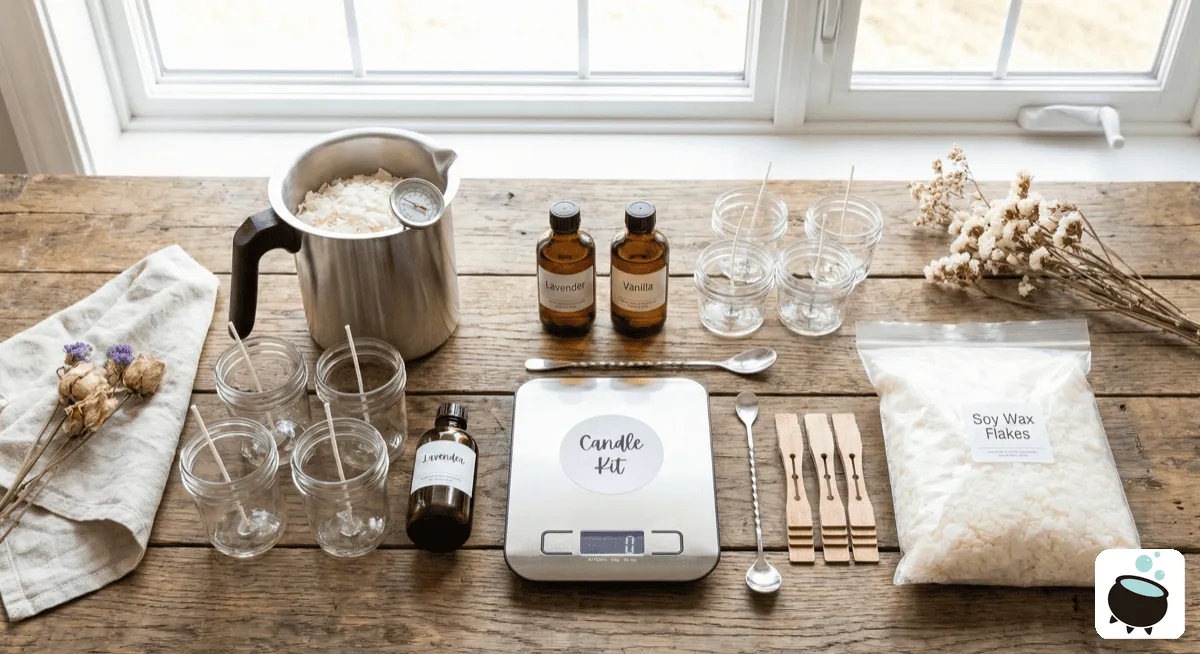
Quick Answer
To make your first candle: melt wax in a double boiler, add fragrance at 185 degrees F (10% of wax weight), pour into a container with centered wick at 135-145 degrees F, let cool undisturbed. Basic supplies cost $50-100. Start with soy wax and pre-tabbed wicks for easiest success.
What You'll Need to Start
Essential Supplies
| Item | Why You Need It | Beginner Cost |
|---|---|---|
| Wax | The candle body | $15-25 (5 lbs) |
| Wicks | To burn the candle | $8-15 (100 pack) |
| Containers | To hold candles | $15-30 (12 jars) |
| Fragrance oil | For scent | $10-20 |
| Pouring pot | To melt wax | $10-20 |
| Thermometer | Temperature control | $8-15 |
| Scale | Measuring accuracy | $15-25 |
| Wick stickers | Secure wicks | $5-8 |
| Wick centering device | Keep wicks straight | $5-10 |
Estimated starter kit cost: $80-170
Choosing Your First Wax
| Wax Type | Difficulty | Notes |
|---|---|---|
| Soy (container) | Easiest | Forgiving, good scent throw |
| Parasoy blend | Easy | Balanced properties |
| Paraffin (container) | Medium | Excellent throw, more technique needed |
| Coconut/apricot | Medium | Trendy, good throw |
| Beeswax | Harder | Expensive, limited fragrance |
Recommendation for beginners: Start with soy container wax. It's forgiving, affordable, and popular.
Choosing Your First Wicks
For beginners, buy pre-tabbed wicks:
- Already attached to metal base
- No assembly needed
- Various sizes available
Size guideline for soy wax:
- 2-2.5" container: CD-6 or ECO-4
- 3" container: CD-10 or ECO-6
- 3.5" container: CD-12 or ECO-10
For more detailed wick selection, see our wick sizing guide.
Step-by-Step: Your First Candle
Step 1: Prepare Your Workspace
- Cover surfaces with newspaper or old towels
- Gather all supplies within reach
- Ensure good ventilation
- Keep water away from hot wax
Step 2: Calculate Wax Needed
For each container:
Container volume (oz) × 0.86 = Wax needed (oz)
Example: 8 oz jar needs about 6.9 oz wax
For multiple candles, multiply and add 10% extra. For precise calculations, use our candle wax calculator.
Step 3: Prepare Containers and Wicks
- Clean containers (remove dust, fingerprints)
- Stick wick sticker to wick tab bottom
- Press wick tab into center of container
- Place wick centering device on top
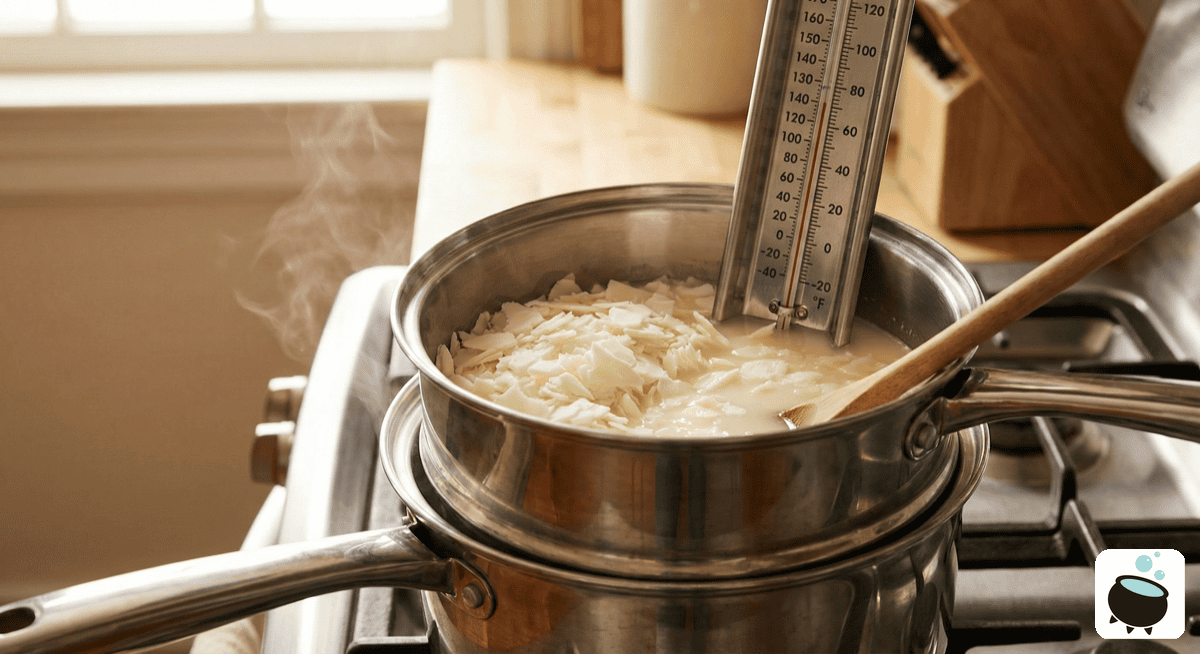
Step 4: Melt the Wax
- Set up double boiler (pot of water + pouring pot)
- Add wax to pouring pot
- Heat water to simmering (not boiling)
- Stir occasionally
- Monitor with thermometer
- Remove from heat when fully melted (170-180 degrees F)
Important: Never heat wax directly over flame. Never leave melting wax unattended.
Step 5: Add Fragrance
- Let wax cool to 185 degrees F (or per wax instructions)
- Calculate fragrance: wax weight x fragrance percentage
- Example: 16 oz wax x 10% = 1.6 oz fragrance
- Pour fragrance into wax
- Stir gently for 2 minutes
For more details on fragrance ratios and maximum loads, see our fragrance load calculator guide.
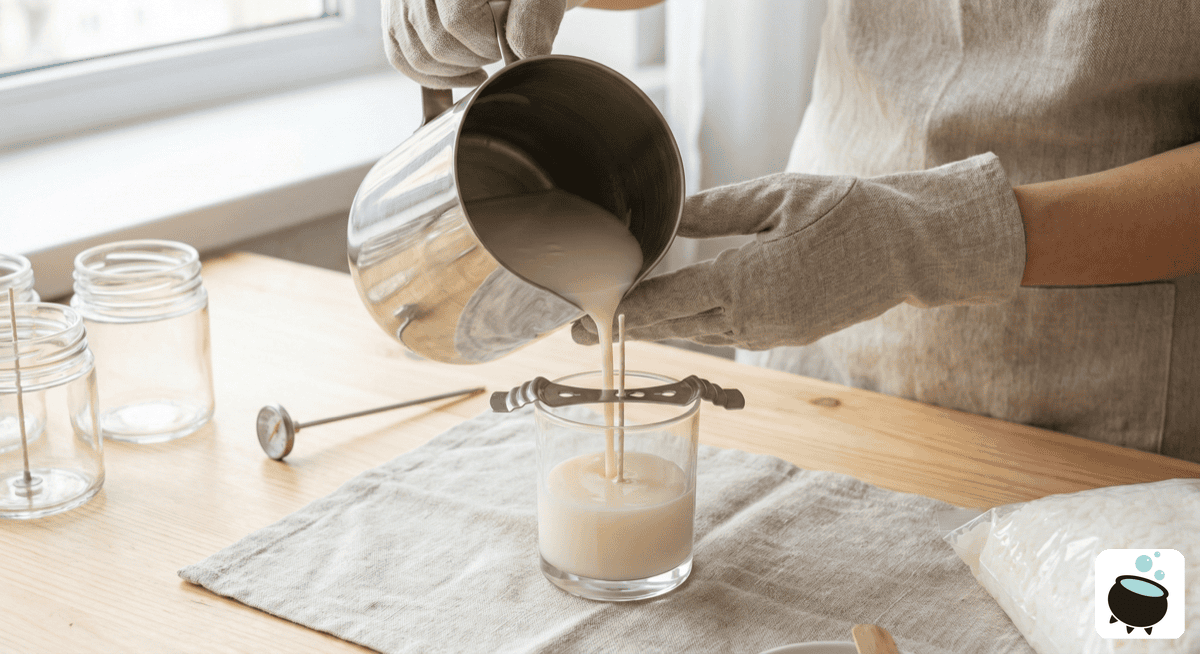
Step 6: Pour the Candle
- Let wax cool to pour temperature (135-145 degrees F for soy)
- Pour slowly and steadily
- Leave 1/4" at top (for potential second pour)
- Adjust wick if it moved
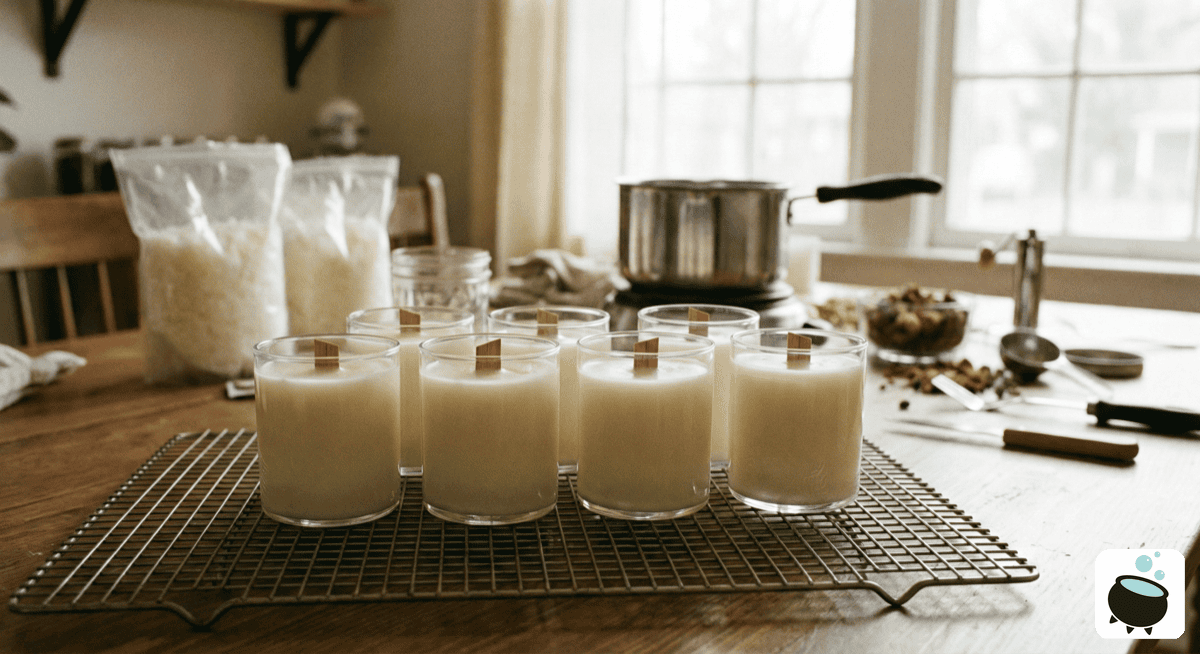
- Don't move candles while cooling
Step 7: Let It Cure
- Allow 24 hours to fully cool
- If sinkholes appear, use heat gun or second pour to fix
- Trim wick to 1/4"
- Wait 1-2 weeks before burning (cure time)
Common Beginner Mistakes
Mistake 1: Wrong Temperature
| Problem | Cause | Fix |
|---|---|---|
| Frosting | Poured too hot | Pour at lower temp |
| Sinkholes | Poured too hot | Pour cooler, or second pour |
| Wet spots | Temperature shock | Warm containers first |
| Poor adhesion | Too cool | Pour at proper temp |
Mistake 2: Wrong Wick Size
| Symptom | Cause | Fix |
|---|---|---|
| Tunneling | Wick too small | Size up |
| Soot on jar | Wick too large | Size down |
| Flame too high | Wick too large | Size down |
| Weak scent | Often wick too small | Size up |
Mistake 3: Too Much Fragrance
Adding more fragrance doesn't mean stronger scent. Too much causes:
- Oil sweating
- Poor burning
- Fire hazard
Stick to your wax's recommended maximum (usually 6-10%).
Mistake 4: Moving Candles While Cooling
Moving cooling candles causes:
- Uneven surfaces
- Wick displacement
- Wet spots
Let candles cool completely undisturbed.
Mistake 5: Not Testing
Always test before selling or gifting:
- Burn test (4 hours)
- Check melt pool, flame height, scent throw
- Test multiple wicks to find the best
Understanding Wax Properties
Pour Temperature
Different waxes need different pour temps:
| Wax Type | Pour Temp Range |
|---|---|
| Soy (container) | 135-145 degrees F |
| Parasoy | 140-160 degrees F |
| Paraffin | 150-170 degrees F |
| Coconut/apricot | 140-150 degrees F |
Fragrance Load
How much fragrance your wax can hold:
| Wax Type | Typical Max Load |
|---|---|
| Soy | 10-12% |
| Parasoy | 10-12% |
| Paraffin | 8-10% |
| Coconut | 10-12% |
Cure Time
Time needed for fragrance to bond with wax:
| Wax Type | Recommended Cure |
|---|---|
| Soy | 1-2 weeks |
| Paraffin | 1 week |
| Coconut | 1-2 weeks |
Troubleshooting Guide
Problem: Sinkholes Around Wick
Cause: Wax shrinks as it cools Fix:
- Second pour with remaining wax
- Heat gun to remelt surface
- Poke relief holes before cooling
Problem: Wet Spots (Adhesion Issues)
Cause: Wax pulling away from glass Fix:
- Pre-heat containers
- Pour at correct temperature
- Cool more slowly
- Note: purely cosmetic, doesn't affect burn
Problem: Frosting (White, Snowy Coating)
Cause: Natural property of soy wax Fix:
- Can't fully prevent in 100% soy
- Purely cosmetic
- Pour at lower temp to minimize
Problem: Weak Scent Throw
Cause: Usually multiple factors Fix:
- Test different fragrance loads
- Try larger wick (bigger melt pool)
- Ensure proper cure time
- Try different fragrances
Problem: Candle Tunneling
Cause: Wick too small for container Fix:
- Size up wick
- First burn should reach edges (1 hour per inch diameter)
Cost Breakdown
Per Candle Costs (8 oz soy candle)
| Item | Amount | Cost |
|---|---|---|
| Wax | 7 oz | $0.75 |
| Wick | 1 | $0.15 |
| Container | 1 jar | $1.00 |
| Fragrance | 0.7 oz | $0.70 |
| Label | 1 | $0.20 |
| Total | $2.80 |
This doesn't include equipment, your time, or overhead—important for pricing if you sell.
Frequently Asked Questions
How long does it take to make a candle?
Active time: 30-45 minutes for a small batch. But candles need 24 hours to cool and 1-2 weeks to cure before burning.
Why does my candle smell stronger cold than when burning?
This is cold throw vs. hot throw. Some fragrances perform differently when burning. Also, try a larger wick for better hot throw.
Can I use essential oils instead of fragrance oils?
Yes, but essential oils are more expensive and some don't perform well in candles (citrus fades quickly). Start with candle-specific fragrance oils.
How do I know when wax is fully melted?
When no solid pieces remain and wax is clear/translucent. Stir and check the bottom of your pot.
Is candle making dangerous?
Hot wax can cause burns and is flammable. Use a double boiler (never direct heat), never leave melting wax unattended, keep water away from wax, and have a fire extinguisher nearby.
How many candles can I make with 5 lbs of wax?
Depends on size. For 8 oz containers: 5 lbs / 7 oz per candle = approximately 11 candles.
Conclusion
Candle making is an accessible craft with a satisfying learning curve. Start with quality supplies, follow proper temperatures, and test your results. Your first candles might not be perfect—that's part of learning.
As you progress, tracking your recipes, temperatures, and results becomes important. Many candle makers use software to record what works, so they can consistently reproduce their best candles.
Take notes, be patient with the curing process, and enjoy creating something beautiful and fragrant.
Ready to Manage Your Recipes Like a Pro?
PotionHub helps soap and candle makers calculate lye, track batches, manage inventory, and grow their business.
Get PotionHub